Obsolete — last-time-buy reality check
The onsemi H11A817B3SD is officially marked obsolete. There is no listed successor or second-source cross-reference from the manufacturer.
5300Vrms isolation — what it buys you
Rated for 5300Vrms isolation between input and output, this optoisolator provides reinforced insulation suitable for safety-barrier applications in industrial controls, power supplies, and medical equipment where galvanic separation is required between a low-voltage DC control side and a higher-voltage load side. The single-channel transistor output is rated for up to 70V collector-emitter voltage and 50mA continuous output current, with a typical Vce(sat) of just 200mV at rated drive — meaning it can directly drive logic inputs or low-power loads without an additional buffer stage.
CTR window and switching speed
This tight binning guarantees consistent gain across a reel, so the designer does not need to over-drive the LED to cover a wide CTR spread — the 130% floor ensures the output transistor saturates reliably even with a 5mA input. Rise and fall times are 2.4µs typical each, placing this part in the medium-speed class for optoisolators. A 2.4µs edge rate supports data rates up to roughly 200 kbps — adequate for status feedback, relay drivers, and 50/60 Hz zero-cross detection, but not for high-speed digital isolation like SPI or CAN.
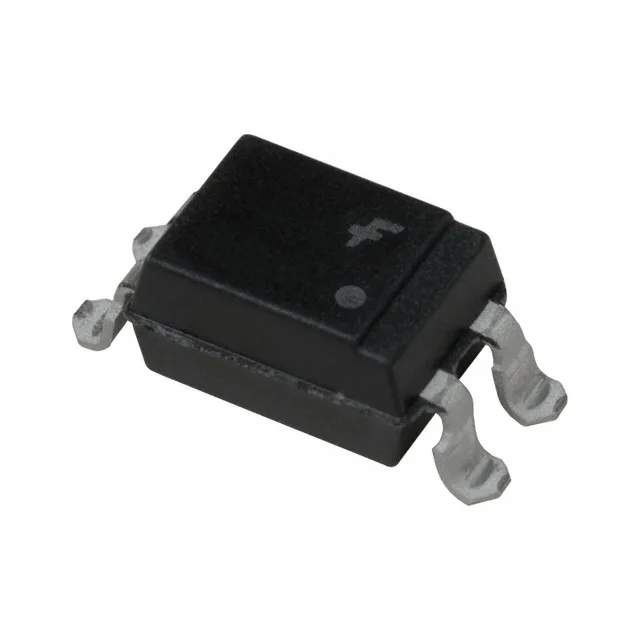
Housed in a 4-SMD gull wing package (4-SMD per the supplier device package designation), the H11A817B3SD is a surface-mount part intended for reflow assembly. The gull-wing leads provide visual solder-joint inspection access and moderate strain relief for the optocoupler body during thermal cycling. Operating temperature spans -55°C to 100°C, covering industrial and some military/aerospace ambient ranges. The DC input type means it is driven by a forward current, not an AC signal — the 1.2V typical forward voltage at If=5mA is standard for an IR LED, and the absolute maximum forward current is 50mA.