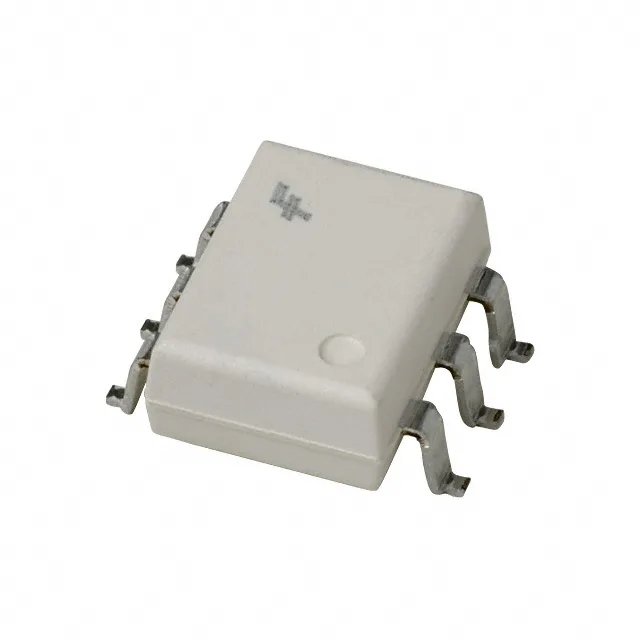
7500Vpk isolation in a 6-SMD gull-wing package
The onsemi H11A5SR2VM is a single-channel optoisolator with a DC input LED and a phototransistor output that brings out the base pin — useful when you need to bias the transistor for faster switching or lower leakage. The 7500Vpk isolation rating means it can hold off high transient voltages across the barrier, making it a candidate for motor-drive feedback, medical patient-interface circuits, or industrial sensor isolation where the common-mode voltage spikes are severe. The 6-SMD gull-wing package sits flat on the board and is reflow-compatible, though the Tape & Reel delivery suggests it was originally intended for volume pick-and-place. The base-product number H11A is a long-running industry-standard footprint — the same pinout appears across multiple manufacturers, so a board laid out for an H11A-series part will accept this device without a layout change.
Transfer ratio and switching speed — what they mean for the BOM
The minimum current transfer ratio (CTR) is 30% at a forward current of 10 mA. This means that with 10 mA through the LED, the output transistor can sink at least 3 mA. For a typical logic-level input to a microcontroller or PLC, that is enough to pull a 10 kΩ pull-up resistor low, but if the load requires more current, you either increase the LED drive or select a higher-CTR variant. The turn-on and turn-off times are both 2 µs typical — symmetric enough for 100 kHz-ish switching, though the base resistor and collector load will shift the actual edge rates. The output transistor is rated for 30 V maximum collector-emitter voltage, and the saturation voltage is 400 mV max at the rated drive — that 400 mV drop is the voltage the load sees when the transistor is fully on. The LED forward voltage is 1.18 V typical, and the absolute maximum forward current is 60 mA, so the series resistor should be sized to keep the LED current below that ceiling across the full temperature range.
onsemi lists the H11A5SR2VM as obsolete. The 6-SMD gull-wing package and the standard H11A pinout mean that a functional replacement from another manufacturer (same footprint, same CTR band) can be cross-referenced at the BOM level, but no single pin-compatible drop-in is guaranteed without verifying the CTR and switching-speed specs against the original design. The surface-mount package with gull-wing leads is easier to inspect and rework than a J-bend or BGA, which matters for low-volume or repair-bench assembly where the part is hand-soldered.