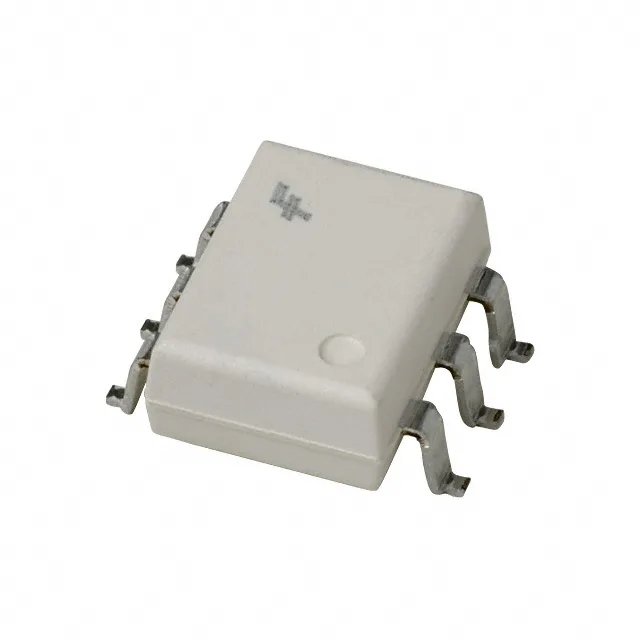
7500Vpk isolation in a 6-SMD gull wing
The onsemi H11A4SM is a single-channel optoisolator with a DC input LED and a phototransistor output that brings out the base terminal. Packaged in a 6-SMD gull wing outline, the H11A4SM is designed for surface-mount assembly. The 6-SMD supplier device package matches the standard DIP-6 footprint but with formed leads for reflow soldering.
CTR floor and switching profile
The minimum current transfer ratio of 10% at 10 mA forward current sets the gain floor — at the rated LED drive, the output transistor conducts at least one-tenth of the input current. This matters for logic-level interfaces where the output must saturate reliably into a known load. Typical turn-on and turn-off times are 2 µs each, giving a combined propagation delay of roughly 4 µs. That places the H11A4SM in the medium-speed class for phototransistor optoisolators — adequate for 50/60 Hz line monitoring, relay driver isolation, and digital input modules where the PLC scan rate is in the millisecond range. The output transistor is rated for 30 V maximum collector-emitter voltage, with a saturation voltage of 400 mV at the rated drive. The 60 mA maximum DC forward current on the input side allows the LED to be driven directly from a 5 V logic output through a current-limiting resistor.