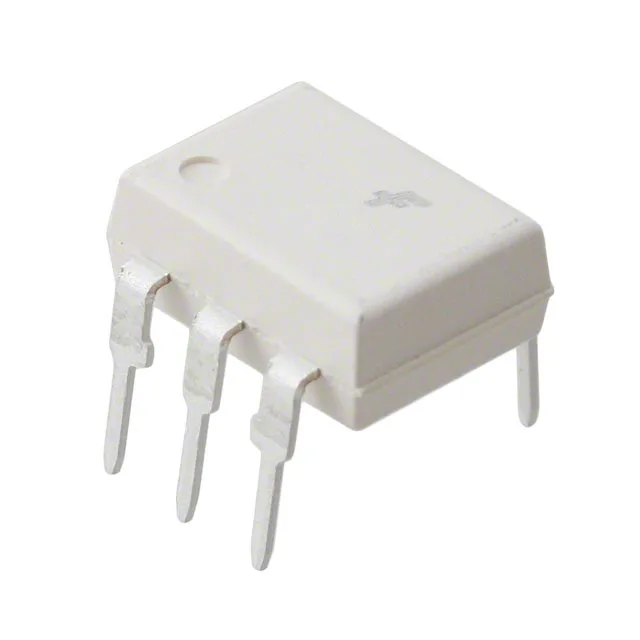
The H11A3VM is classified as Obsolete by onsemi, meaning the manufacturer has discontinued production and no longer supports new orders through its authorized distribution network.
7500Vpk isolation — the safety barrier spec
The H11A3VM provides 7500Vpk isolation between input and output — this is the headline rating for applications requiring a reinforced safety barrier, such as medical equipment, industrial motor drives, and power supply feedback loops where galvanic isolation protects low-voltage control circuits from high-voltage transients. The 6-DIP through-hole package (0.300-inch body width, 7.62mm lead spacing) is the legacy footprint for socketed or wave-solder boards. The through-hole format provides mechanical robustness in high-vibration environments compared to surface-mount alternatives.
CTR and switching speed — what they mean for the drive margin
The minimum Current Transfer Ratio (CTR) is 20% at a forward current of 10mA. This means that with 10mA through the input LED, the output transistor can sink at least 2mA. The designer must budget this minimum CTR across temperature and LED aging — at 100°C the CTR typically drops to 50-70% of the 25°C value, so the actual drive margin at temperature may be tighter than the 20% figure suggests. Turn-on and turn-off times are both 2µs typical. This sets the practical switching ceiling at roughly 250 kHz for a 50% duty cycle, though the actual maximum frequency is lower when accounting for load capacitance and the output pull-up resistor. For applications below 100 kHz, the 2µs switching speed is adequate for most logic-level signal isolation. The transistor output with base access allows the designer to bias the base for faster switching or to use the base pin for a feedback compensation network — a feature not available on Darlington-output optocouplers.
Operating range and input drive limits
The H11A3VM operates from -40°C to 100°C, covering industrial temperature environments. The maximum continuous forward current through the input LED is 60 mA, and the typical forward voltage at rated current is 1.18V. The output transistor can handle up to 30V collector-emitter with a saturation voltage of 400mV maximum. The DC input type means this optocoupler is designed for steady-state or low-frequency AC signals — it is not intended for high-speed digital communication like I²C or SPI without additional external circuitry.