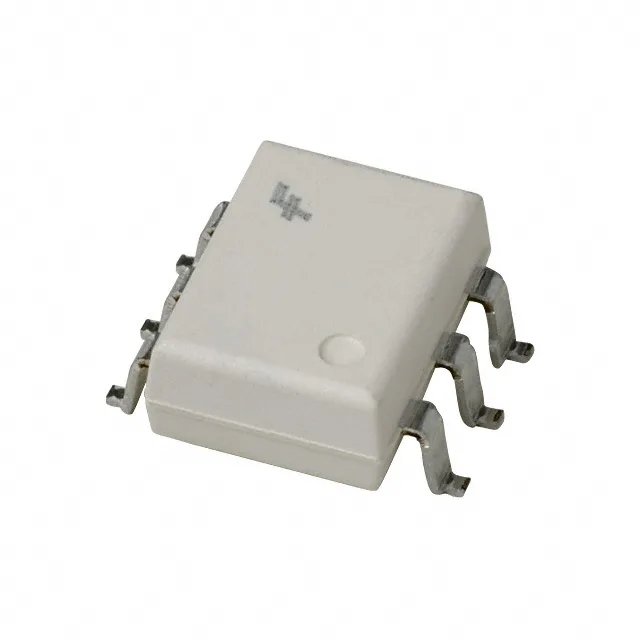
The H11A3SM: Quantities are lot-specific and confirmed at RFQ; no official successor or pin-compatible replacement is recorded from onsemi.
The 7500Vpk isolation rating is the peak transient voltage the optocoupler can withstand between input and output for 60 seconds per UL 1577. This is a reinforced-insulation level — suitable for isolating a 24 VDC PLC input from a 230 VAC motor drive bus, or for medical equipment where patient-contact isolation demands a high margin above the working voltage. The 20% minimum current transfer ratio at 10 mA forward current means the output transistor saturates when the LED is driven with 10 mA and the collector load draws up to 2 mA. For a typical 5 V logic input with a 2.2 kΩ pull-up, the 2 mA output current is enough to pull the line low — but the 20% CTR floor means the LED drive must be sized for the worst-case part, not the typical 50% CTR.
Switching speed and temperature range
Typical turn-on and turn-off times are 2 µs each. This limits the part to data rates below about 250 kbps — fine for 24 VDC digital inputs, relay drivers, or 50/60 Hz zero-crossing detection, but too slow for high-speed serial isolation like SPI or CAN. The 100°C ceiling covers most industrial control cabinets and outdoor telecom enclosures, but the CTR derates with temperature — at 85°C the minimum CTR may drop below 20%, so the LED drive current should be increased by 20-30% to guarantee saturation across the full temperature range.
Supplied in a 6-SMD gull wing package, 7.62 mm lead pitch, standard DIP-6 footprint. The surface-mount gull wing leads require a solder paste stencil aperture of about 0.6 × 1.2 mm per pad for a reliable fillet. No exposed pad — thermal management is through the leads only, so the part dissipates about 150 mW max at 25°C ambient without forced air. The 6-SMD package is the same footprint as the through-hole DIP-6 version — a PCB laid out for the through-hole part can accept the SMD variant with a reflow profile change and no board spin.