Triac output with 600 V off-state for AC load switching
The FODM3053V-NF098: This makes it suited for switching low-power AC loads — solenoids, small relays, or TRIAC gate drives — where galvanic isolation between the control side and the line-voltage side is required. The 3750 Vrms isolation rating between input and output provides basic insulation for mains-referenced circuits, certified under cUR, UR, and VDE. That triple certification covers North American and European safety regimes without additional testing.
Minimum static dV/dt is 1 kV/µs. In a switching application driving an inductive load — a contactor coil or a small motor — this immunity prevents the Triac from self-triggering on the fast voltage transient that appears across the output when the load is switched off. Below this slope, the output stays off; above it, the device may latch on falsely. The LED trigger current (Ift) is 5 mA maximum, with a typical forward voltage of 1.2 V. The 60 mA absolute maximum forward current gives headroom for pulse drive or higher ambient temperature derating. Hold current (Ih) is 300 µA typical. Once triggered, the Triac output latches on until the load current drops below this threshold — typically at the zero-crossing of the AC waveform. This is a non-zero-crossing device, meaning the output can be triggered at any phase angle, enabling phase-angle control for dimming or soft-start.
Surface-mount package and temperature grade for automated assembly
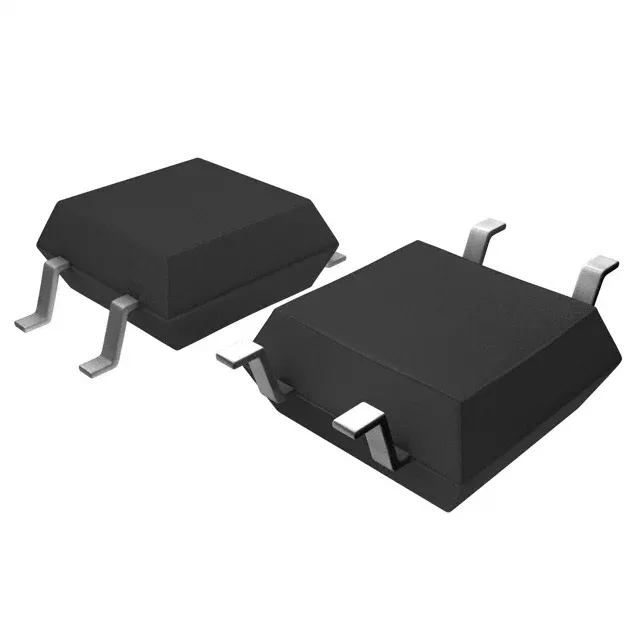
Housed in a 4-SMD Gull Wing package with a supplier device package designation of 4-SMD, the FODM3053V-NF098 is designed for reflow soldering on standard PCB assemblies. The Gull Wing leads provide visual solder-joint inspection access and are compatible with no-clean flux processes. This covers most industrial enclosures, HVAC controls, and appliance boards without active cooling. The hold current and trigger current are specified at room temperature; expect some shift at the temperature extremes per the typical curves in the full datasheet.
Approvals include cUR, UR, and VDE. These cover UL 1577 and VDE 0884-10 isolation standards, which are the common requirements for safety-isolated interfaces in industrial and commercial equipment.