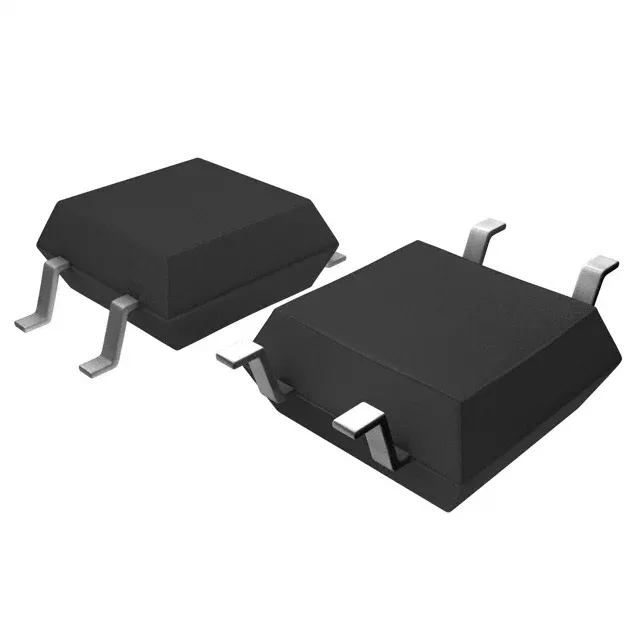
Triac output for AC load switching with 3750Vrms isolation
The FODM3053R2-NF098 is a 1-channel triac-output optoisolator from onsemi, designed to drive low-current AC loads such as solenoid valves, relays, or small motors while providing 3750Vrms galvanic isolation between the microcontroller-side LED and the line-side triac. The 600 V off-state voltage rating covers 120 VAC and 240 VAC mains with healthy margin for line surges. A minimum static dV/dt of 1kV/µs on the output side ensures the triac does not falsely trigger from fast line transients or commutating noise — a common failure point in motor-drive and relay-coil circuits.
Parametric deep-dive: trigger current, hold current, and temperature range
Once triggered, the triac latches on until the load current drops below the 300 µA typical hold current (Ih). The on-state RMS current rating is 70 mA maximum, suitable for low-power loads like solid-state relay inputs, indicator lamps, or small AC solenoids. The forward voltage drop across the LED is 1.2 V typical at rated forward current.
Active production, ROHS3 compliant, surface-mount package
The ROHS3 compliance mark confirms it meets current EU substance restrictions without exemption conflicts. The cUR and UR agency approvals simplify global equipment certification paths.
Design-in note: no zero-crossing circuit, plan edge triggering
The FODM3053R2-NF098 does not include a zero-crossing detection circuit. The triac fires immediately when the LED current exceeds the trigger threshold, regardless of the AC line phase. This is typical for random-phase (phase-angle) control applications like resistive heater modulation or soft-start circuits. For zero-cross switching of inductive loads, select a sibling with integrated zero-cross circuitry.