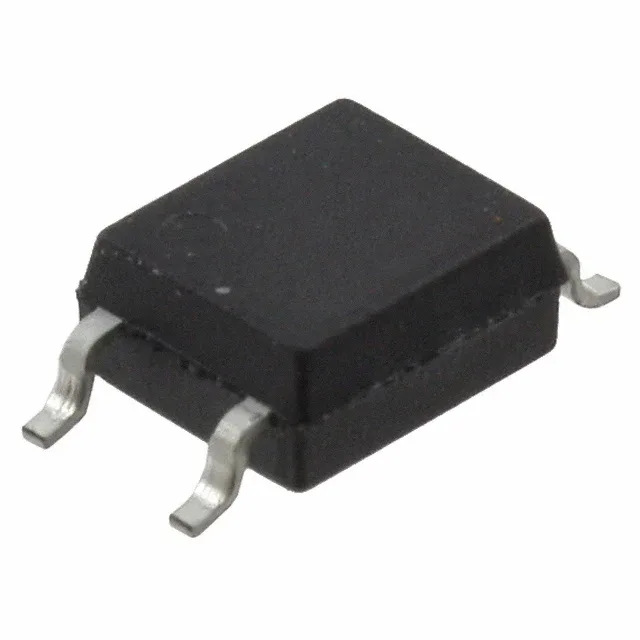
Active random-phase triac driver — 400 V off-state, 10 mA trigger
The onsemi FODM3022R2V-NF098 is a 1-channel triac output optoisolator in a surface-mount 4-SMD gull wing package (4-MFP). It switches AC loads up to 400 V off-state with a random-phase (non-zero-crossing) output, meaning the triac fires immediately on the LED trigger pulse — no delay to the next AC zero crossing. This suits phase-angle control or pulse-skip modulation where the load must turn on at any point in the AC cycle. The LED trigger current is 10 mA max, and the on-state RMS current is 70 mA max — a small-signal triac rated for driving a gate of a larger power triac or a low-current AC load directly. Isolation is 3750 Vrms, sufficient for basic insulation between low-voltage control and line-voltage load.
dV/dt and switching environment
Static dV/dt is 10 V/µs typical — this is the minimum rate of rise of off-state voltage that the triac can withstand without self-triggering. In a random-phase driver, the triac sees the full AC line voltage step at turn-off; 10 V/µs is adequate for most 50/60 Hz resistive and inductive loads but may need an external snubber in high-noise environments like motor drives or relay-coil switching. Operating temperature spans -40°C to 100°C, covering industrial control cabinets and outdoor equipment. The forward voltage is 1.2 V typical at the LED, and the DC forward current is rated to 60 mA max — the 10 mA trigger threshold leaves margin for LED current derating over temperature.
For a BOM line originally specified around MOC3011SM, the FODM3022R2V-NF098 is a drop-in functional alternative — same 1-channel triac output, same 400 V off-state, same surface-mount 4-SMD gull wing footprint. The key difference is the static dV/dt: 10 V/µs typical vs the MOC3011's unspecified but generally lower rating. In a low-noise resistive load (solenoid, lamp, heater), the swap is transparent; in an inductive or noisy circuit, verify the dV/dt margin with a snubber.