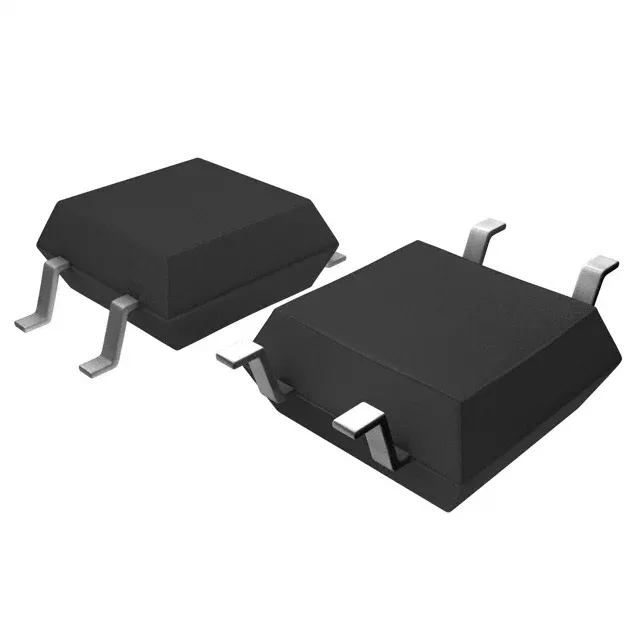
Triac output optoisolator for AC load switching
The FODM3022R2-NF098 from onsemi is a 1-channel optoisolator with a Triac output, designed to drive AC loads such as relays, solenoids, and small motors from a low-voltage control side. It provides 3750Vrms galvanic isolation between the logic-side LED and the power-side triac, meeting basic safety isolation requirements for many industrial and appliance applications. With a 400 V off-state voltage rating and a typical static dV/dt of 10V/µs, this part handles 120/240 VAC line switching with reasonable immunity to false triggering from line transients — a practical choice for resistive and lightly inductive loads. The absence of a zero-crossing circuit (random-phase triggering) means the triac fires immediately when the LED is forward-biased, making it suitable for phase-control dimming, solid-state relay output stages, or any application where the turn-on point must be controlled relative to the AC waveform.
Trigger current and hold current margins
The maximum LED trigger current (Ift) is 10 mA, and the typical hold current (Ih) is 300 µA. The 60 mA maximum DC forward current (If) gives headroom for pulsed drive or higher ambient temperatures. The on-state RMS current rating of 70 mA limits the continuous load to small relays or logic-level triacs; for higher loads, the FODM3022R2-NF098 drives an external power triac or SCR.
Submit an RFQ through the storefront to lock in delivery terms.
The 4-SMD Gull Wing package has a 2.54 mm pin pitch typical for this class, compatible with standard SMD soldering profiles. The operating temperature range of -40°C to 100°C covers industrial and outdoor environments, though the LED forward voltage (1.2V typ at 25°C) will shift with temperature — account for this in the drive resistor calculation across the full range. The approvals cUR and UR indicate UL-recognized component status, which simplifies safety certification for end equipment in North American markets.