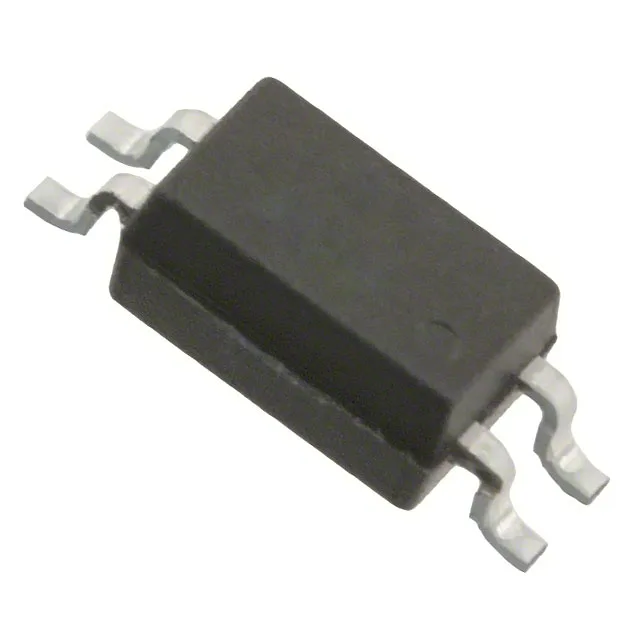
What the isolation and temperature range mean for your BOM
The FODM214's 3750Vrms isolation (cite:) covers reinforced insulation for mains-referenced circuits in industrial controls, power supplies, and motor drives — enough to pass 250 VAC basic isolation with margin. Unlike many phototransistor optos that only accept DC forward current, the FODM214's AC/DC input (cite:) lets it sense AC line zero-cross directly — no external bridge rectifier needed, saving two diodes and a filter cap on the primary side.
CTR spread and switching speed — the design-in tradeoffs
Current transfer ratio spans 20% to 400% at 1 mA forward current (cite:,). That wide spread means the designer must size the pull-up resistor for the minimum CTR at the actual LED current to guarantee the output transistor saturates — at 1 mA If, a 20% CTR delivers only 0.2 mA to the load, which may not drive a logic input without a high-value pull-up. This 3 µs edge rate limits the part to switching frequencies below roughly 50 kHz — fine for relay drivers, PLC inputs, and isolated serial interfaces, but not for high-speed isolated SPI or gate-drive feedback.
onsemi lists the FODM214 as Active (cite:) with ROHS3 compliance (cite:). The 4-SOP package (cite:) is the standard SOIC-4 footprint used across the FODM214 series, so a layout designed for this part can also accept the FODM217BR2V (cite:) or FODM217A (cite:) if supply tightens — both are DC-input only, so the AC/DC capability is lost in a swap.