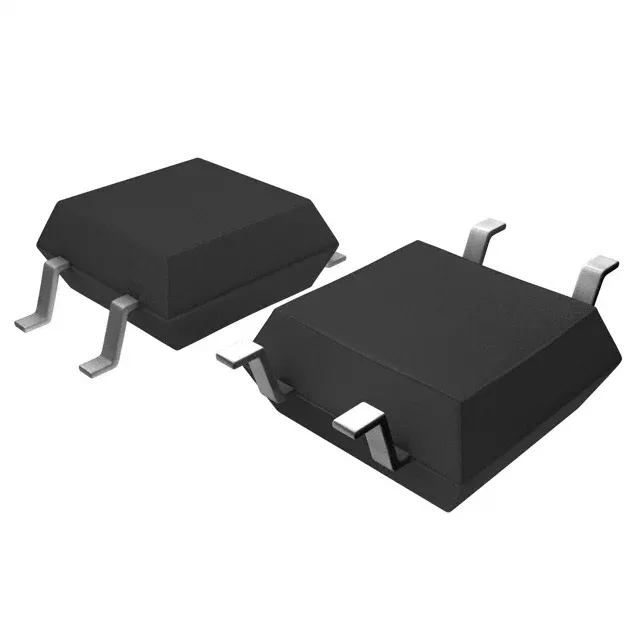
Isolation barrier and CTR — what drives the BOM fit
The FODM1008R2: Rated 5000Vrms isolation — this is the one-minute withstand voltage between input and output sides. For a motor-drive or PLC digital input that sees 600V peak transients on the field side, 5kV gives a full decade of margin above the working voltage. The 4-SMD Gull Wing package with a 4-SOP footprint keeps the creepage distance short — about 8mm across the body — so the isolation rating depends on the PCB slot or gap under the part, not just the package itself. Current transfer ratio spans 130% min to 260% max at 5mA forward current. That means with 5mA into the LED, the output transistor can sink at least 6.5mA and up to 13mA. If your downstream logic input requires 2mA guaranteed, the 130% floor gives 3.2× margin at 5mA drive. The CTR window also tells you the LED degradation budget: over 100k hours the LED output drops maybe 20%, and the 130% floor still leaves headroom before the output falls below the logic threshold.
Switching speed and output drive — what the 5.7µs rise time means for your signal
Rise time 5.7µs typ, fall time 8.5µs typ. That sets the maximum practical data rate at roughly 40-50 kbps — fast enough for 24V DC discrete signals, slow enough that a 100kHz PWM will be distorted. For a 1kHz encoder pulse train the edges are clean; for a 20kHz switching signal the output will slew-rate limit and the pulse width at the receiver will shrink. The 300mV Vce saturation max keeps the output transistor's dissipation under 15mW at 50mA load — negligible in a 4-SOP package with no heatsink. Output transistor rated 70V collector-emitter max and 50mA continuous. That covers 24V and 48V industrial rails with margin. The 1.4V forward voltage typ at the LED with a 50mA absolute-max forward current means the LED drive resistor is sized for the CTR curve: at 5mA the LED drops about 1.4V, so a 3.3V logic output needs a 380Ω series resistor to hit 5mA.
Active lifecycle and compliance — no end-of-life watch needed
Operating temperature range -40°C to 110°C covers industrial enclosures and outdoor cabinet ambient. The 110°C upper limit is below the 125°C automotive grade but fine for most factory-floor and building-automation applications. The DC input type and transistor output are the classic phototransistor topology — no base pin, so the switching speed is set by the phototransistor's own capacitance and the load resistor.