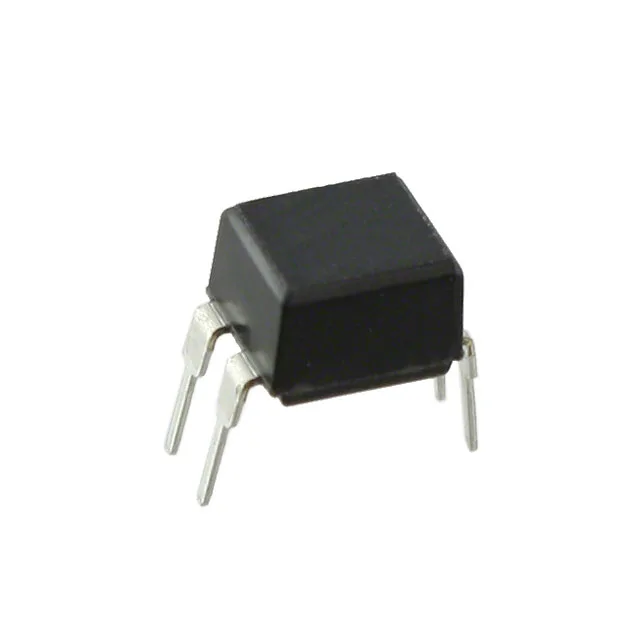
Why the isolation rating matters for your barrier design
The FOD817B delivers 5000Vrms isolation in a 4-DIP through-hole package — that is the figure that decides whether it meets reinforced-insulation creepage for a 240 VAC motor-drive barrier or a flyback supply feedback loop. DC input only, transistor output, single channel. The 70 V max collector-emitter voltage and 50 mA continuous output current handle the logic-level side of the isolation gap.
CTR bin B — the gain window that sets the LED drive
The FOD817B is binned for a current transfer ratio of 130% to 260% at 5 mA forward current. That middle gain band means the designer can set the LED forward current between roughly 2 mA and 8 mA and still guarantee the output transistor saturates below 200 mV. Compared to the FOD817A (80%–160% CTR) and the FOD817C (200%–400% CTR), the B bin is the most commonly specified for general-purpose isolated feedback and signal coupling — it gives enough headroom for LED aging without overdriving the phototransistor base.
Active production — no end-of-life clock ticking
No LTB notice, no successor announced. ROHS3 compliant. The 4-DIP (0.300", 7.62mm) footprint is a standard through-hole layout — no special reflow profile, no moisture sensitivity level to track.
Switching speed and output saturation — what the numbers mean
That limits the useful switching frequency to roughly 50–100 kHz for isolated gate drive or signal coupling — fast enough for a 50/60 Hz mains-isolated feedback loop or a low-speed PLC input, but not for a high-frequency SMPS loop. Maximum Vce saturation is 200 mV at the rated output current.