Isolation and off-state voltage — the safety barrier
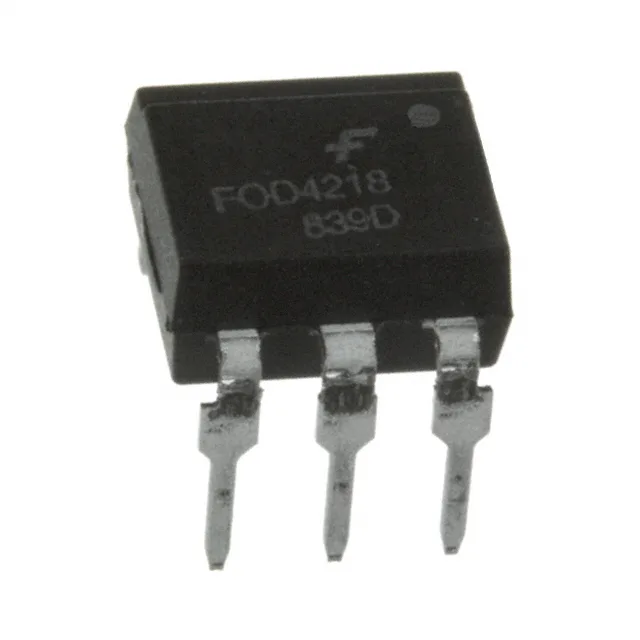
The FOD4218: Rated for 5000 Vrms isolation between input and output — this is the reinforced-insulation level required for mains-isolated control interfaces in industrial equipment. The 800 V off-state voltage gives headroom above 480 VAC line peaks (which sit around 678 V peak), so the triac blocks the full mains swing without avalanche. The 10 kV/µs minimum static dV/dt means the output triac does not false-trigger on fast voltage transients from inductive load switching or relay contact bounce — a key spec for snubberless or minimal-snubber designs.
Drive current and firing — low-power interface
The 1.28 V typical forward voltage at 30 mA max forward current means the LED drop is predictable across the operating temperature range of -55°C to 100°C. No zero-crossing circuit — the triac fires on the first gate pulse regardless of the AC line phase. This suits phase-angle firing applications (heater control, dimming) where the turn-on point is modulated, not just on/off switching at zero-cross.
Package and board integration — 6-DIP through-hole
Through-hole mounting suits prototype builds, high-vibration environments where socketed or soldered DIPs are preferred over SMT, and rework-friendly designs. Supplied in tube packaging — the tube quantity is the standard handling unit for through-hole DIP devices at assembly houses.
Approvals and compliance — regulatory acceptance
Carries cUL, FIMKO, and UL approvals — accepted in North American (UL/cUL) and European (FIMKO as a CB-scheme member) installations. ROHS3 compliant per onsemi's current material declaration.