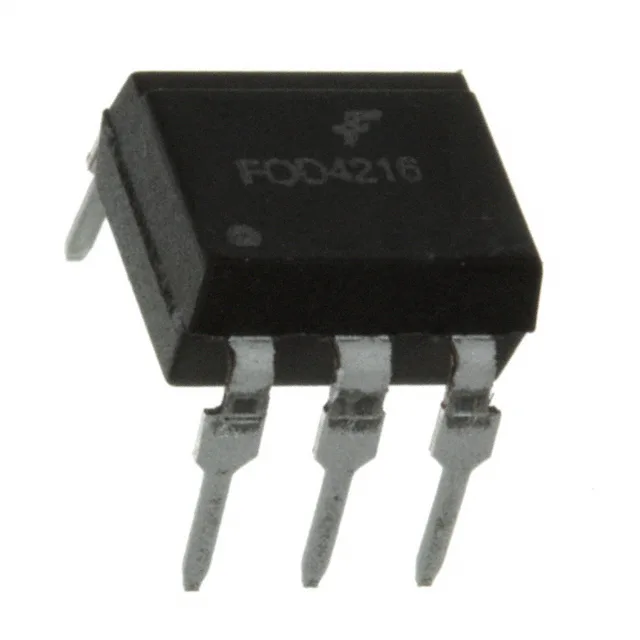
The FOD4216SDV comes in a 6-SMD gull-wing package with a surface-mount footprint.
Triac output and switching performance
This optoisolator drives a triac output rated for 600 V off-state and a minimum static dV/dt of 10 kV/µs — that high dV/dt immunity means it resists false triggering from fast voltage transients on the AC line, a critical spec for driving inductive loads like motors or solenoids where switching edges can couple back into the gate. Turn-on time is 60 µs, and the LED trigger current (Ift) is 1.3 mA max, so a low-current logic output from a microcontroller or PLC can switch it directly without an extra driver stage. The hold current (Ih) is 500 µA — once triggered, the triac stays latched until the load current drops below that threshold, which is typical for AC load control. There is no zero-crossing circuit, so the triac fires immediately when the LED is energized — this gives faster response for phase-angle control or random-turn-on applications, but also means higher inrush if switching into a capacitive load.
Isolation and approvals
Isolation is rated at 5000 Vrms, which covers reinforced insulation requirements for mains-connected equipment in industrial and appliance designs. The part carries approvals from cUL, FIMKO, UL, and VDE — the VDE mark is especially relevant for European markets where the optocoupler must meet EN 60747-5-5 for safe isolation. Operating temperature spans -55°C to 100°C, covering industrial and outdoor enclosures where ambient heat or cold can stress the LED and triac junction. ROHS3 compliant per the lifecycle record.
No stock-holding claim — each order is quoted to the buyer's quantity.