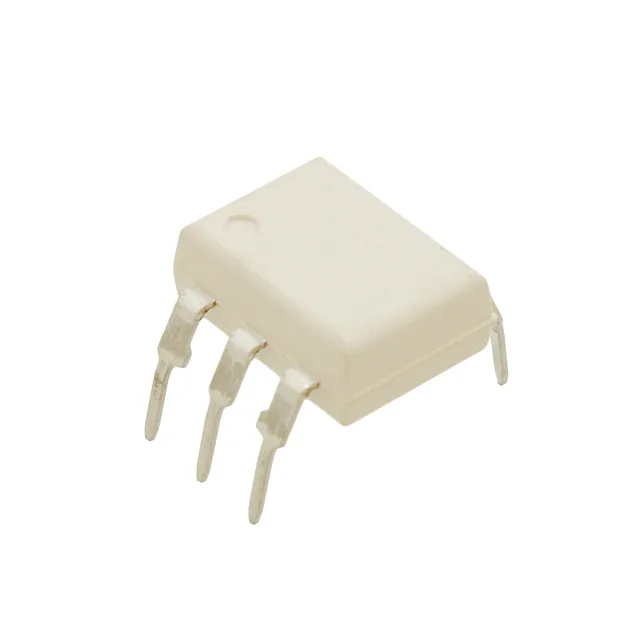
What the triac output and 600 V off-state mean for your load
The FOD420TV is a random-phase triac-output optoisolator — it has no zero-crossing circuit, so you can fire the triac at any point in the AC cycle. That makes it the right choice for phase-angle dimming, soft-start motor drives, and heater control where you need to vary power, not just switch on at zero cross. Off-state voltage is rated 600 V, which covers 240 VAC line applications with margin. The 5000 Vrms isolation between input and output meets reinforced insulation requirements for industrial and appliance designs.
dV/dt immunity and why it matters on a noisy line
Minimum static dV/dt is 10 kV/µs — that is the slew rate the triac can withstand across its output terminals without false triggering. In a motor-drive or relay-switching environment where line transients are common, this rating keeps the load off when it should be off. The LED trigger current maximum is 2 mA, and the hold current is 500 µA typical.
Active production, through-hole package, and compliance
Approvals include cUL, FIMKO, UL, and VDE — the major safety agency marks for North American and European markets.