Triac output with zero-crossing — clean AC switching
The FOD4118TV is a 1-channel optoisolator with a triac output and built-in zero-crossing circuit, rated for 5000 Vrms isolation and 800 V off-state voltage. That 800 V off-state means it handles 240 VAC and 277 VAC line voltages with plenty of headroom, and even 480 VAC line-to-line in some designs — just watch the peak voltage. The zero-crossing circuit fires the triac only near the AC zero point, which cuts inrush current and radiated EMI when switching resistive loads like heaters or incandescent lamps.
10 kV/µs dV/dt — false-trigger immunity in noisy plants
A static dV/dt rating of 10 kV/µs means the output triac won't falsely trigger from fast voltage spikes on the AC line — common in motor-drive cabinets or near welding equipment. Many older triac-output optos (like the MOC3073M) only offer 1 kV/µs, so this part is a step up for industrial environments where line noise is a given. The 60 µs turn-on time is fine for line-frequency switching (50/60 Hz) but not for high-speed PWM — keep that in mind if you are thinking about dimming or phase-angle control.
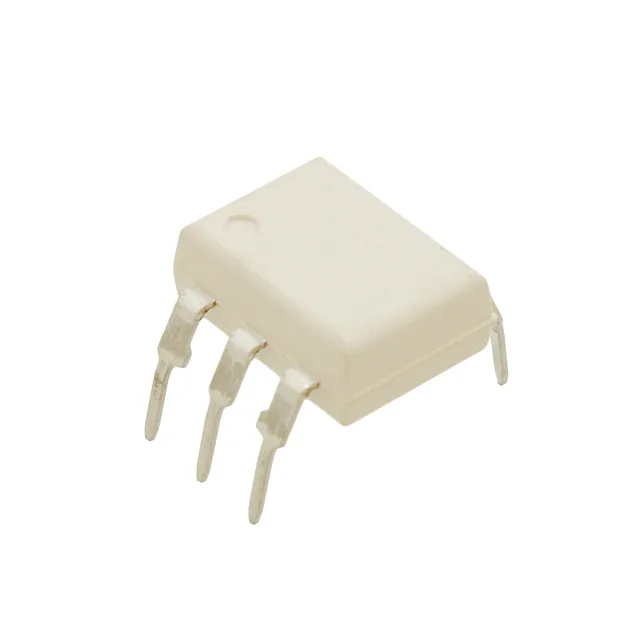
Through-hole DIP-6 — field-swappable, no reflow needed
Housed in a 6-DIP package with 0.400-inch (10.16 mm) body width, the FOD4118TV uses standard 0.1-inch pin spacing. That is a socket-friendly footprint — you can swap it on site with a basic soldering iron or even use a DIP socket for field replacement. No hot-air station, no reflow profile. Bulk packaging means it ships in tubes, not tape-and-reel, which is typical for through-hole parts and fine for prototype or low-volume builds.