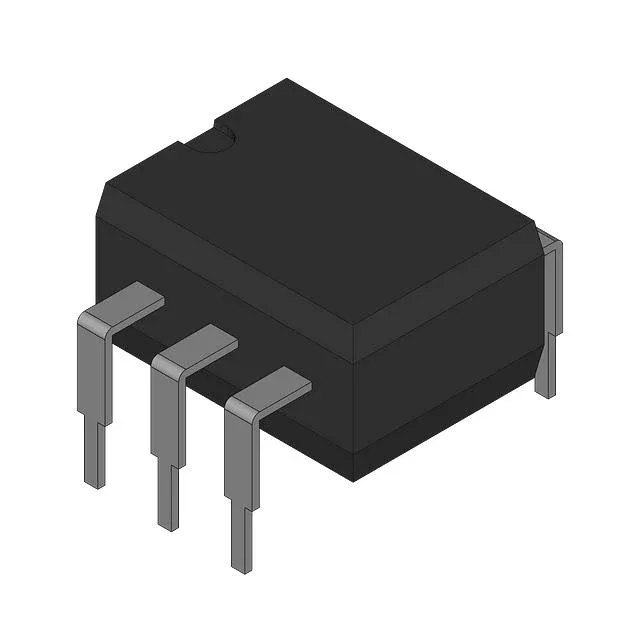
Triac output with zero-crossing for clean AC switching
The onsemi FOD4116V is a 1-channel optoisolator with a Triac output, designed to switch AC loads from a low-voltage control side. The built-in zero-crossing circuit turns on the Triac only near the AC voltage zero point, which minimizes inrush current and radiated EMI — a real help when driving inductive loads like solenoids or small motors without extra snubber components. Rated for 600 V off-state voltage and 5000 Vrms isolation, this part comfortably handles 240 VAC line switching with safety margin for transient spikes. The 10 kV/µs minimum static dV/dt means the output won't falsely trigger from fast voltage changes on the AC line — important in industrial environments with motor drives or switching power supplies nearby.
Low trigger current simplifies MCU interface
Forward voltage is 1.25 V typical, and the LED can handle up to 30 mA continuous, giving plenty of headroom for reliable turn-on over temperature. Once triggered, the Triac holds on with a 500 µA hold current, which is low enough to stay latched with small resistive loads but still releases cleanly when the LED drive stops. The 60 µs turn-on time is fast enough for most 50/60 Hz phase-control or on/off switching applications.
Through-hole 6-DIP package for breadboard-friendly builds
Housed in a 6-DIP package with 0.400-inch (10.16 mm) body width, the FOD4116V is through-hole mount — easy to hand-solder on perfboard or breadboard, and a good fit for maker projects or low-volume prototypes. The supplier device package is listed as 6-DIP, and it ships in Bulk, so you get loose tubes or trays rather than tape-and-reel. Operating temperature spans -55°C to 100°C, covering industrial and some automotive under-hood environments. Safety approvals from CSA, UL, and VDE mean the part is recognized for use in mains-isolated designs across North America and Europe.