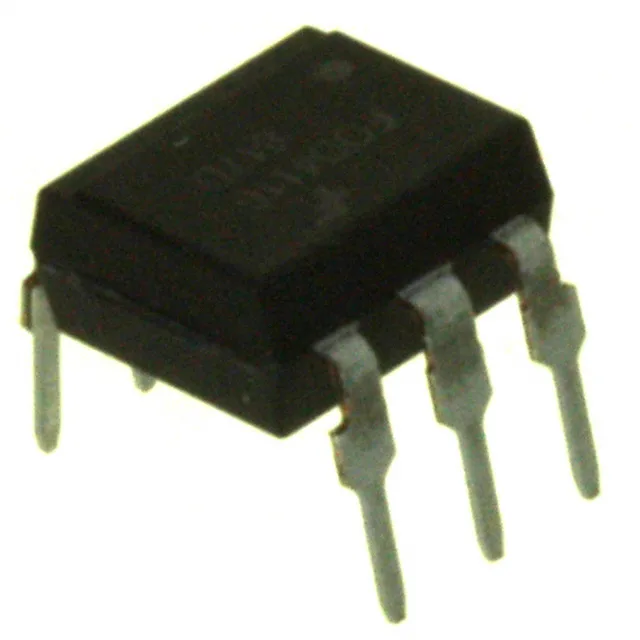
Triac output with zero-crossing for clean AC switching
The onsemi FOD4116 is a 1-channel optoisolator with a Triac output and integrated zero-crossing circuit, packaged in a 6-DIP (0.400", 10.16 mm) through-hole package. It is rated for 5000 Vrms isolation, making it suitable for driving AC loads like solenoids, valves, and lighting ballasts where galvanic separation between the control logic and the mains side is required.
Noise immunity and load drive — the 10 kV/µs dV/dt matters
The static dV/dt rating of 10 kV/µs minimum means the output TRIAC will not falsely trigger on fast voltage transients from inductive loads or relay bounce — a critical parameter when switching motors or contactors in a panel with other noisy gear. The 600 V off-state voltage gives headroom for 240 VAC or 277 VAC lighting circuits. The zero-crossing circuit turns on the TRIAC only when the AC voltage crosses zero, which limits inrush current into resistive loads like heaters or incandescent lamps. The trade-off is a turn-on delay of up to half a mains cycle (8.3 ms at 60 Hz), so for phase-angle dimming or fast switching, a non-zero-crossing optoisolator would be the correct choice. The 500 µA holding current ensures the TRIAC stays latched on with loads as light as a few watts.
Active lifecycle — no end-of-life risk for new designs
The operating temperature range of -55°C to 100°C covers outdoor enclosures, unheated warehouses, and equipment near ovens or furnaces. The through-hole DIP package is still widely used in power electronics where vibration resistance is less critical than solder-joint reliability under thermal cycling.