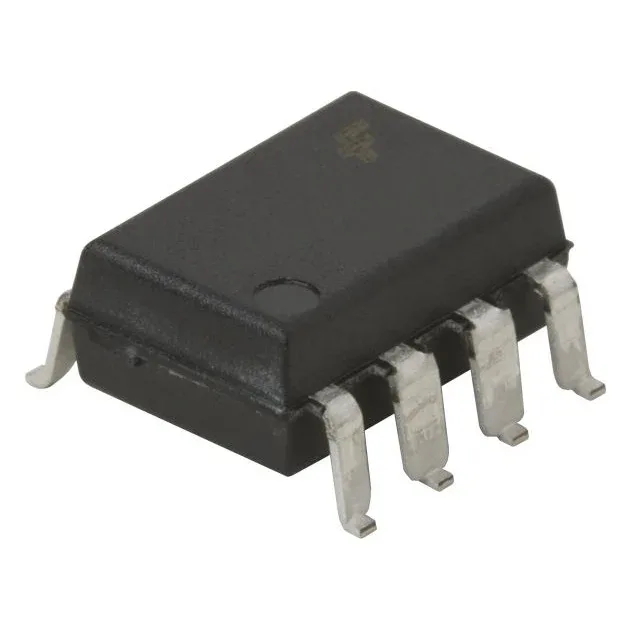
Isolation barrier and switching speed for IGBT/MOSFET gate drive
The onsemi FOD3150TSR2V is a 1-channel gate drive optocoupler in an 8-SMD Gull Wing package, designed to drive IGBTs and power MOSFETs with a 1.5 A peak output current sourced from a 15 V to 30 V supply rail. The 5000 Vrms isolation rating, certified to IEC and UL standards, provides reinforced isolation between the low-voltage control side and the high-voltage power stage — sufficient for motor drive and inverter applications where the DC bus sits at 400 V or higher.
CMTI and propagation delay — what they mean for the switching edge
Common-mode transient immunity (CMTI) is rated at a minimum 20 kV/µs — this means the output state holds through a fast dV/dt event across the isolation barrier, such as the voltage step at the IGBT collector during hard switching. An optocoupler with insufficient CMTI can glitch the gate drive and cause shoot-through. Maximum propagation delay is 500 ns (tpLH and tpHL), with a pulse-width distortion ceiling of 300 ns. For a 20 kHz switching frequency (50 µs period), this delay consumes 1% of the cycle — acceptable for most motor-drive and power-supply loops, but budget it into the dead-time calculation to avoid cross-conduction. Typical rise and fall times are 60 ns each into the load — the gate resistor and the IGBT input capacitance (Cies) set the actual switching edge, not the optocoupler alone.
Output drive current and supply range
The output stage can source and sink 1 A each (high and low), with a 1.5 A peak pulse capability — enough to charge and discharge the gate capacitance of a medium-power IGBT (e.g., 30-50 A rated) within the switching cycle. The 15 V to 30 V output supply range matches the typical gate drive voltage for standard IGBTs (15 V on, -5 V to -15 V off) and allows direct connection to the power stage bias rail without an external regulator.
Active lifecycle and compliance documentation
RoHS3 compliant (2011/65/EU amendment 2015/863) — no exemption-restricted substances above the threshold limits. Certified to IEC and UL standards for reinforced isolation — the approval agency listing confirms the part has passed the required production lot testing for safety-rated isolation.