Gate-drive optocoupler for IGBT and MOSFET switching
The FOD3120SD is a single-channel optocoupled gate driver from onsemi, built for driving IGBTs and power MOSFETs in inverter and motor-drive stages. It delivers 3 A peak output current with 2 A source and 2 A sink capability, enough to charge and discharge the gate capacitance of medium-power switching devices without an external booster stage. Isolation is rated at 5000 Vrms, backed by UL recognition, so it holds up in equipment where the control side and the high-voltage power stage must be galvanically separated — think VFDs, UPS systems, and industrial power supplies where a fault on the bus must not reach the logic side. Common-mode transient immunity is a minimum 35 kV/µs, which means the output stays in the correct state even when the power-stage midpoint switches at tens of kilovolts per microsecond — the kind of edge rate you see in hard-switched IGBT bridges. If the CMTI is too low, the optocoupler's output glitches and the inverter leg shoots through.
Timing and drive performance for the switching loop
Propagation delay is 400 ns max for both low-to-high and high-to-low transitions, with pulse-width distortion held to 100 ns max. That asymmetry budget matters when the gate driver is part of a dead-time calculation — a 100 ns mismatch between turn-on and turn-off edges eats into the programmed dead time and, if the margin is thin, can cause cross-conduction in the half-bridge. Rise and fall times are 60 ns typical into the rated load, so the gate voltage transitions cleanly without a long Miller plateau. The 15 V to 30 V output supply range means the same part works with standard 15 V gate drives and with higher-voltage IGBT gate rails up to 30 V. The LED forward voltage is 1.5 V typical, and the maximum continuous forward current is 25 mA — a standard logic-level or microcontroller output can drive it directly through a series resistor, no extra transistor stage needed.
Package, rework, and board-fit notes
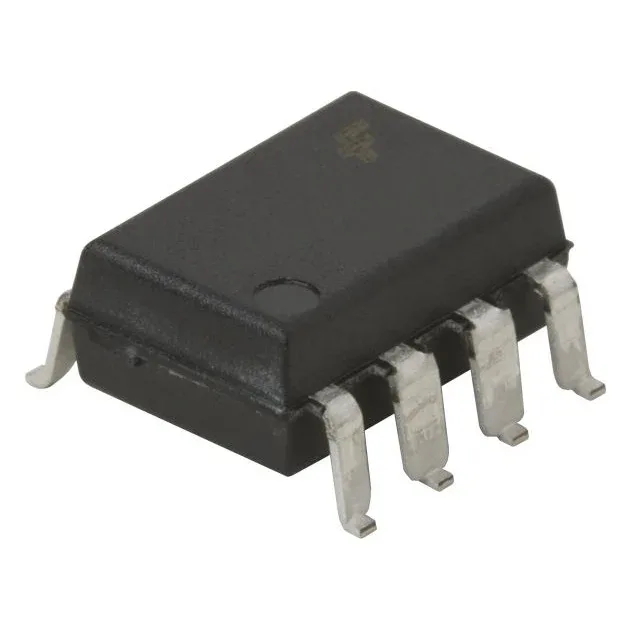
Housed in an 8-SMD Gull Wing package, the FOD3120SD sits flat on the board with the leads formed outward — the same footprint as the industry-standard DIP-8 optocoupler layout, so it drops into existing pads without a layout change. The gull-wing leads are inspectable after soldering and easier to hand-rework than a J-bend or BGA package. No derating headache at 85°C ambient.
UL recognition is noted on the spec — the approval covers the 5000 Vrms isolation rating, which is what the safety engineer and the NRTL inspector look for on the BOM.