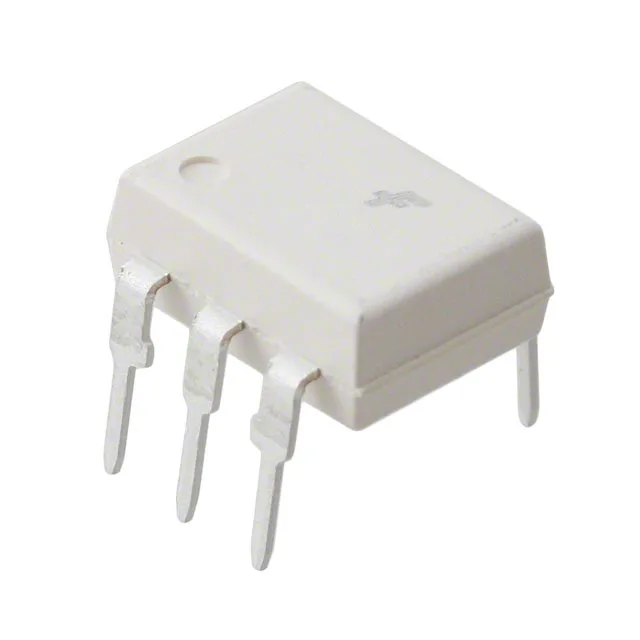
5300 Vrms isolation in a 6-DIP through-hole package
The CNY17F1: The through-hole body suits wave-solder assembly and manual rework in low-volume or prototype builds.
40-80% CTR at 10 mA — the gain window for the BOM
Current transfer ratio (CTR) is specified at 40% minimum and 80% maximum, both at a forward current of 10 mA. This 2:1 spread means the designer must budget the minimum CTR for the logic-high threshold at the receiver and the maximum CTR to avoid saturating the output transistor too hard — a classic optocoupler gain-budget exercise. The output transistor is rated for 70 V collector-emitter and 50 mA continuous current per channel, with a Vce(sat) of 300 mV max — the drop when the transistor is fully on, which sets the output low-level voltage for the downstream logic or PLC input.
2 µs turn-on, 3 µs turn-off — switching speed for 10-100 kHz signals
Typical turn-on time is 2 µs and turn-off time is 3 µs; rise and fall times are 1 µs and 2 µs respectively. These figures place the CNY17F1 in the medium-speed optocoupler class — suitable for 10-100 kHz switching signals, serial data at 115200 baud, and PWM feedback in isolated power supplies, but not for high-speed digital buses like CAN or Ethernet. The input is a DC-driven LED with a typical forward voltage of 1.35 V and a maximum continuous forward current of 100 mA. The 1 µs rise time means the LED driver must source the peak current fast enough to avoid stretching the turn-on edge.
-55°C to 100°C — industrial temperature grade
The 100°C ceiling is below the 125°C automotive grade, so this part is not AEC-Q101 qualified — it is intended for factory-floor and infrastructure equipment, not under-hood or engine-bay environments.