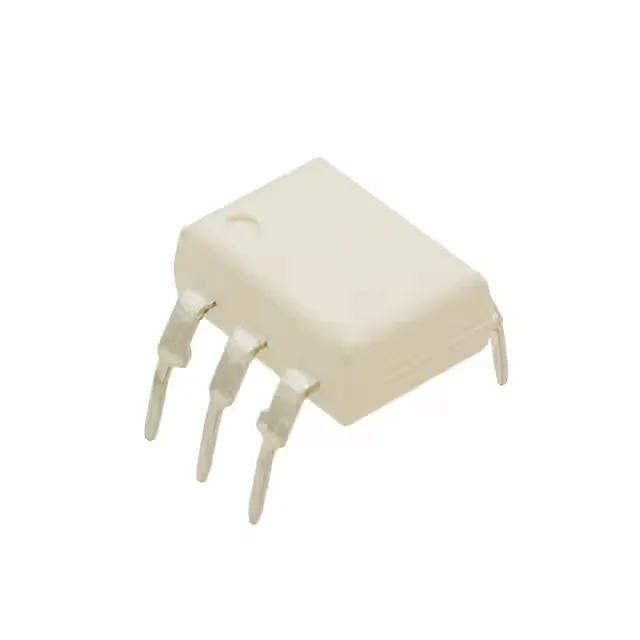
onsemi has marked the CNY174TM as Obsolete. No official successor or pin-compatible replacement is recorded from the original manufacturer.
Isolation and signal transfer — what the ratings mean
Rated for 4170Vrms isolation between input and output — this is a reinforced-grade barrier for a single-channel optocoupler, suitable for breaking ground loops in industrial control, motor drive feedback, and isolated sensor interfaces where the primary-side transient exceeds basic 2500Vrms levels. Current transfer ratio spans 160% to 320% at a forward current of 10mA. The wide CTR spread means the output transistor saturates with as little as 3.1 mA of input drive at the minimum CTR, but a design should bias for the worst-case 160% to guarantee the output pulls low across temperature and unit-to-unit variation. Switching is specified with a 4 µs rise and 3.5 µs fall time (max), and turn-on/turn-off times of 2 µs and 3 µs typical. This puts the CNY174TM in the medium-speed band — adequate for 50/60 Hz line synchronisation, relay drivers, and logic-level isolation up to about 100 kHz, but not for high-speed digital buses like SPI or I²C.
Output and input ratings — design margins
The output transistor can handle up to 70V collector-emitter voltage and 50mA continuous current per channel. That 70V ceiling covers most 24V and 48V industrial rails with headroom, but a 60V rail leaves only 10V margin — consider a higher-voltage opto if transients are expected. On the input side, the LED forward voltage is 1.35V typical, and the maximum continuous forward current is 60mA. The 6-DIP through-hole package fits standard 0.100-inch pitch sockets or solders directly into a PCB — no special reflow profile needed.