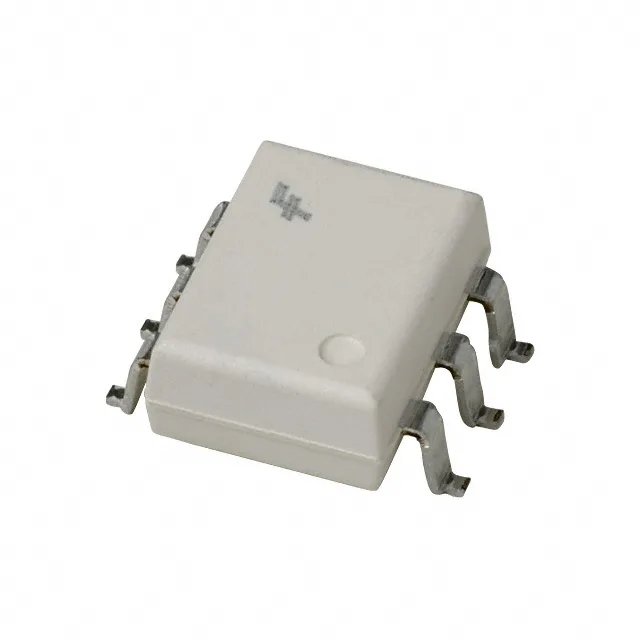
7500Vpk isolation in a single-channel SMD optocoupler
The onsemi CNY172FR2M is a single-channel optoisolator in a 6-SMD Gull Wing package, delivering 7500Vpk isolation between a DC-input LED and a phototransistor output with a base connection. This isolation rating suits it for applications where reinforced insulation is required across a safety barrier — think motor-drive feedback, industrial PSU feedback loops, or PLC digital input isolation where the working voltage stays below the 70 V output ceiling.
CTR window and switching-speed budget
A 63% floor at 10 mA If means the output sinks at least 6.3 mA, enough to pull a 5 V TTL input low through a 680 Ω pull-up. Switching speed is characterised by 1 µs typical rise and 2 µs typical fall times, with turn-on at 2 µs and turn-off at 3 µs typical. This places the part in the medium-speed band — adequate for 10-100 kHz PWM feedback or serial data at 115.2 kbps, but not for high-speed isolated communication like CAN or Ethernet. The output transistor is rated for 70 V collector-emitter maximum and 50 mA continuous current per channel, with a 400 mV typical saturation voltage at the rated forward current. This gives enough headroom to drive a 24 V PLC input or a 12 V relay coil through a base resistor.
The base product number is CNY172, which shares the same 6-SMD Gull Wing footprint and 7500Vpk isolation rating across the family. If a design can tolerate a different CTR bin or output configuration, other CNY172 variants may be parametric alternatives, but no direct drop-in replacement is documented.
Package and board-fit for the 6-SMD Gull Wing
The 6-SMD Gull Wing package (supplier device package 6-SMD) is a surface-mount form factor with gull-wing leads that extend beyond the body for visual solder-joint inspection. The package is supplied in Tape & Reel (TR), compatible with standard pick-and-place equipment. The LED forward voltage is 1.35 V typical at 10 mA, with an absolute maximum forward current of 60 mA. The input is DC only — no AC drive capability. The base connection on the output side allows the designer to bias the phototransistor for faster switching or to implement a Darlington pair externally.