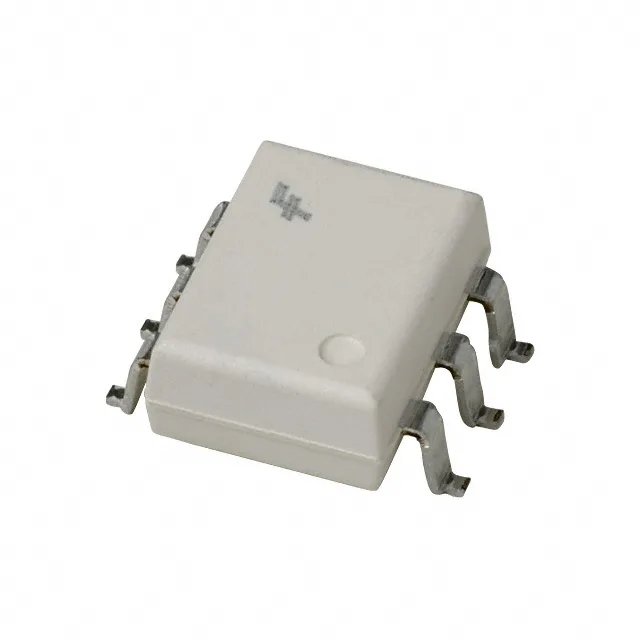
The CNY171SM: RoHS3 compliance is confirmed, so the part passes the current EU restriction directive without an exemption.
Isolation voltage and CTR — the two numbers that decide the fit
Rated for 4170Vrms isolation between the LED input and the phototransistor output. This is a reinforced-grade isolation level that covers mains-powered industrial equipment up to a 300V working voltage with a 1.2/50µs impulse withstand — the typical spec for a motor-drive or PLC digital input barrier. Current transfer ratio is specified as 40% minimum and 80% maximum, both at 10mA forward current. The CTR range tells you the gain spread from unit to unit: at the min end, a 10mA LED drive yields 4mA collector current; at the max, 8mA. That 2:1 tolerance means the downstream load resistor must be sized for the worst-case (lowest) CTR to guarantee the output saturates across all temperature and ageing conditions. Output transistor is rated for 70V Vce(max) and 50mA continuous collector current. This covers 24V logic rails with plenty of headroom, and the 50mA limit is enough to drive a small relay coil, a PLC input, or a gate of a downstream MOSFET with a series base resistor.
Switching speed and temperature — timing closure in the isolation barrier
Rise and fall times are 4µs and 3.5µs typical, respectively. Turn-on time is 2µs, turn-off time is 3µs. This puts the usable data rate around 100 kbit/s — fine for status feedback, relay drives, or 1-wire sensor buses, but not for high-speed SPI or CAN isolation where you need sub-µs propagation delays. The upper limit is 100°C, not 125°C, so the part is suited for industrial enclosures and outdoor telecom cabinets but not for under-hood automotive or direct engine-bay mounting without derating.
Package and board integration — 6-SMD Gull Wing
Housed in a 6-SMD Gull Wing package with a supplier device package code of 6-SMD. The Gull Wing leads are standard for surface-mount optocouplers — they provide a visible solder joint for AOI and enough standoff to prevent flux trapping under the body. The 6-pin footprint is shared with the classic 4N25/4N35 series in SMD packages, so a board laid out for 4N25SR2M accepts the CNY171SM without a PCB spin — same pinout, same pad geometry. The base terminal (pin 6) is brought out on the CNY171SM, which is a difference from simpler transistor-output optos that omit the base connection.