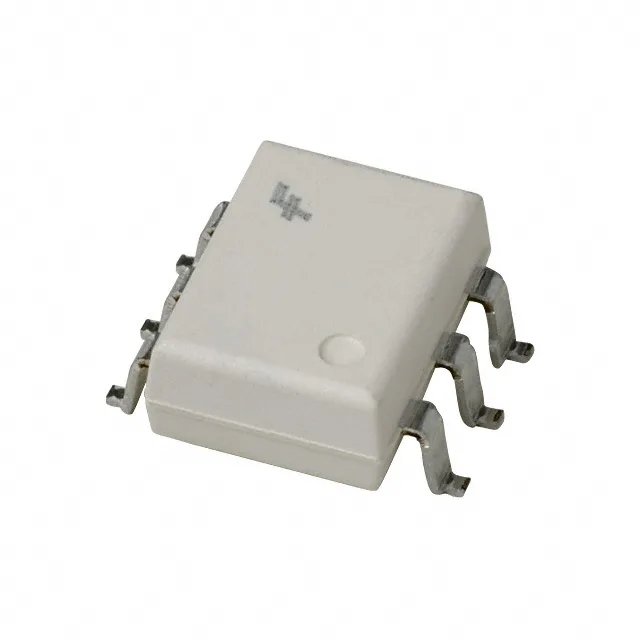
4170Vrms isolation — what it means for the BOM
The CNY171FM provides 4170Vrms galvanic isolation between input and output. This rating is the withstand voltage between the LED and the phototransistor — it certifies the part for reinforced insulation in mains-isolated circuits, such as AC-DC power supplies, motor drive feedback paths, and industrial sensor interfaces where the control side must be protected from the high-voltage bus. The 1-channel DC input drives the internal IR LED; the output is a phototransistor with a base terminal brought out. The base access lets the designer bias the transistor for faster switching or higher gain — a feature not available on simpler optocouplers that only expose the collector and emitter.
CTR and switching speed — the real selection parameters
Current Transfer Ratio (CTR) is specified at 40% minimum and 80% maximum, both measured at If=10mA. The 40% floor guarantees the phototransistor will saturate with a 10mA LED drive, delivering at least 4mA into the output load — enough to drive a logic gate input or a small relay coil. The 80% ceiling prevents overdrive that would slow turn-off due to stored base charge. Turn-on time is 2µs typical, turn-off 3µs typical; rise/fall times are 4µs and 3.5µs max respectively. This switching speed suits data rates up to roughly 100 kbit/s — adequate for status feedback, fault signalling, and low-speed isolated serial links, but too slow for high-speed communication like I²C or CAN.
Output capability and temperature range
The phototransistor is rated for 70V collector-emitter voltage and 50mA continuous output current. Operating temperature spans -40°C to +100°C, covering industrial and outdoor equipment enclosures.