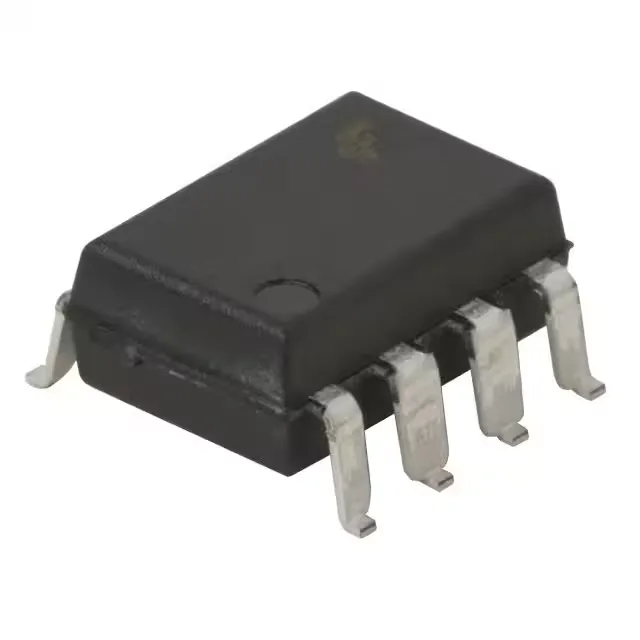
The 6N139SDM is a single-channel optoisolator from onsemi with a DC input and a Darlington transistor output that includes a base pin — giving you the option to add a speed-up resistor or bias network to tailor the switching response. The 5000Vrms isolation rating makes it suitable for breaking ground loops in industrial PLC I/O, motor-drive feedback, and medical patient-interface barriers where galvanic separation is a regulatory requirement. The trade-off is switching speed: turn-on is 240ns typical, but turn-off stretches to 1.3µs, which limits practical data rates to well below 1 Mbps — fine for status signals, fault flags, or 50/60 Hz zero-cross detection, but not for high-speed serial links.
Package, temperature grade, and board-fit reality
Housed in the 8-SMD Gull Wing package, the 6N139SDM sits above the board on formed leads — the stand-off helps with creepage distance across the isolation barrier, but the gull-wing footprint also means the part is sensitive to solder-joint stress if the PCB flexes. The -40°C to 100°C operating range covers most industrial enclosures and outdoor telecom cabinets, though the upper limit is 25°C short of the 125°C common in under-hood automotive — check your ambient worst-case before committing. The base pin on the Darlington output is the key differentiator from a standard photodarlington. If you leave it floating, the turn-off time is slowest; tying a resistor (typically 10–100 kΩ) from base to emitter pulls stored charge out faster, dropping the turn-off time closer to the turn-on figure. The datasheet typical numbers (240ns on, 1.3µs off) assume no external base resistor — factor that into your timing budget.