5 kVrms galvanic isolation for industrial signal paths
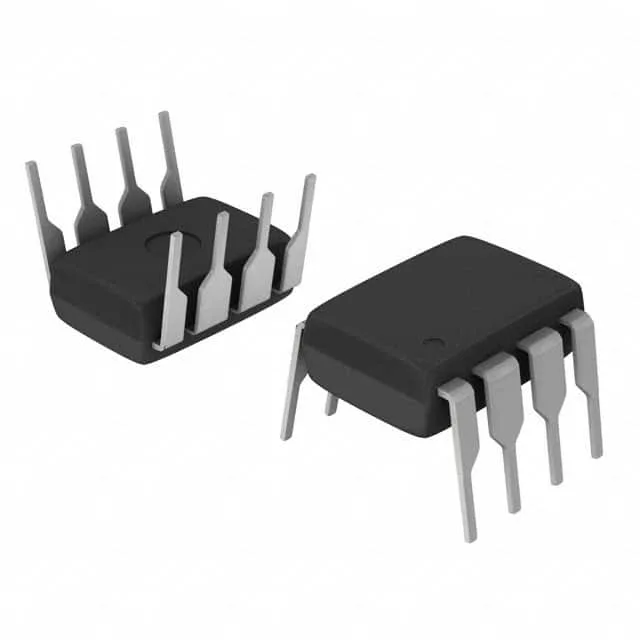
The 6N139M from onsemi is a single-channel Darlington-output optocoupler rated for 5000Vrms isolation — the spec that matters for breaking ground loops between a 24 V PLC input module and the backplane logic. The 8-DIP through-hole package (0.300-inch body width) mates with standard DIP sockets or solders directly into plated-through holes, common on industrial I/O cards and motor-drive control boards. The Darlington output with a separate base pin allows the designer to add an external pull-down resistor to adjust the switching threshold or to disable the output during power-up sequencing.
CTR floor and timing for the BOM trade-off
Minimum current transfer ratio of 500% at 1.6 mA forward current means the output can sink 60 mA while the LED is driven by less than 2 mA from a 3.3V or 5V logic pin — no external transistor needed. Turn-on time is 240 ns typical, turn-off is 1.3 µs. The asymmetry is inherent to the Darlington output — the base storage delay dominates the turn-off. For a PLC input sampling at 1 kHz or a relay coil driver, that 1.3 µs off-time is invisible. For a PWM signal above a few kHz, the duty-cycle distortion from the asymmetry needs a budget check.
Active production, ROHS3, and sourcing posture
Surface-mount siblings (6N139SVM, 6N139SDM) share the same die and isolation rating but come in SMD wide-body packages. Quoted to order against BOM quantity. The tube quantity is typically 50 per tube for this package; factor that into the pick-and-place or hand-assembly yield if ordering partial tubes.
Package and footprint fit for through-hole assembly
8-DIP (0.300-inch, 7.62 mm row spacing) — the standard 0.100-inch pitch DIP footprint. The 8-DIP supplier device package is the same body as the 6N139 in the same tube. The base pin (pin 6 on the Darlington) is left open or pulled to ground; it is not a no-connect. If the layout already uses a 6N138 socket, check the pinout — the 6N139 base pin replaces the 6N138's separate photodiode and transistor output, so the external resistor network changes.