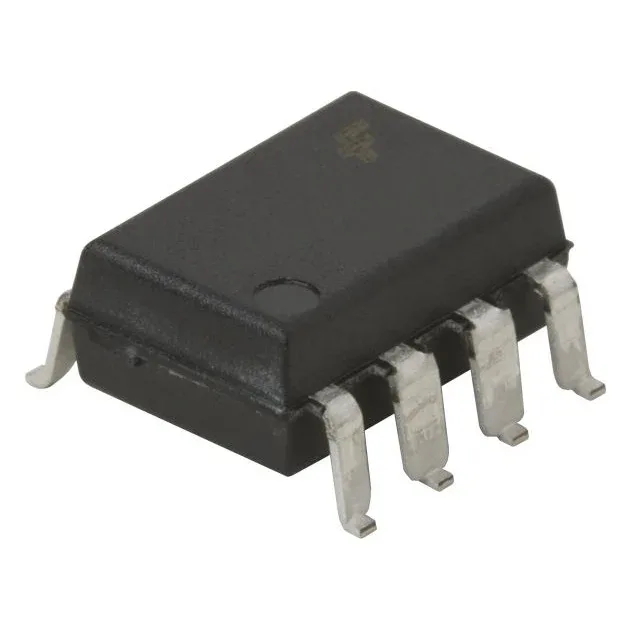
What the 10 Mbps data rate and 75 ns propagation delay mean for your design
The 6N137SDV: Propagation delay is 75 ns max for both tpLH and tpHL, which limits the maximum switching frequency to roughly 6.6 MHz in a push-pull signal path; above that the output pulse width narrows until the downstream receiver misses edges.
Isolation barrier and CMTI — the safety-critical specs
Rated for 2500 Vrms isolation, this optoisolator provides basic isolation per IEC 60950-1 for a 250 V working voltage environment — not reinforced, so it suits signal isolation in industrial control and data-comm interfaces where the barrier sees transient overvoltages rather than continuous mains. Common-mode transient immunity is 10 kV/µs typical, meaning the output does not glitch when a fast transient (like an ESD event or motor-drive switching edge) couples across the isolation barrier — critical for maintaining data integrity in noisy factory-floor or automotive environments.
Supply, input, and output — what the driver needs
Input side requires a forward current of up to 50 mA at 1.4 V typical Vf — the LED driver must source that current from a 5 V rail through a series resistor; the 50 ns rise and 12 ns fall times keep the optical link fast enough for the 10 Mbps data rate.
onsemi has marked the 6N137SDV as Obsolete.