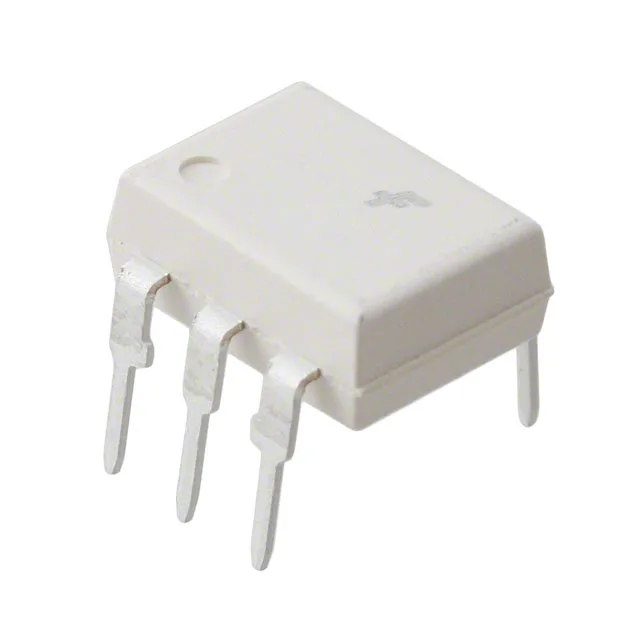
Galvanic isolation with a base pin for bias flexibility
The 4N37M is a single-channel optoisolator from onsemi that couples a DC-input LED to a phototransistor with a separate base connection. The base pin lets you set the switching threshold with an external resistor or bias network, which is useful when you need to adjust the turn-on point independent of the LED drive current. Rated for 4170Vrms isolation, it fits applications where the control side must be electrically isolated from the load — think PLC digital inputs, motor drive feedback, or AC mains detection circuits.
Minimum current transfer ratio is 100% at If=10mA. That means with 10mA through the LED, the phototransistor can sink at least 10mA collector current while keeping Vce below 300mV. If your load needs more collector current, scale the LED drive proportionally — but stay under the 60mA absolute maximum forward current. The 300mV Vce saturation at 10mA collector current is the floor for the output voltage drop when the transistor is fully on. In a 5V logic interface, that leaves 4.7V at the collector — enough to guarantee a logic-high into a CMOS input. For higher collector currents, expect Vce(sat) to rise; the datasheet curve shows the trade-off.
For a through-hole optoisolator in a mature package, this means stable supply and no forced redesign — the kind of part you can qualify once and leave in the BOM for years. The 6-DIP body is 0.300-inch wide, which is the industry-standard DIP-6 width — compatible with sockets and automatic insertion equipment.