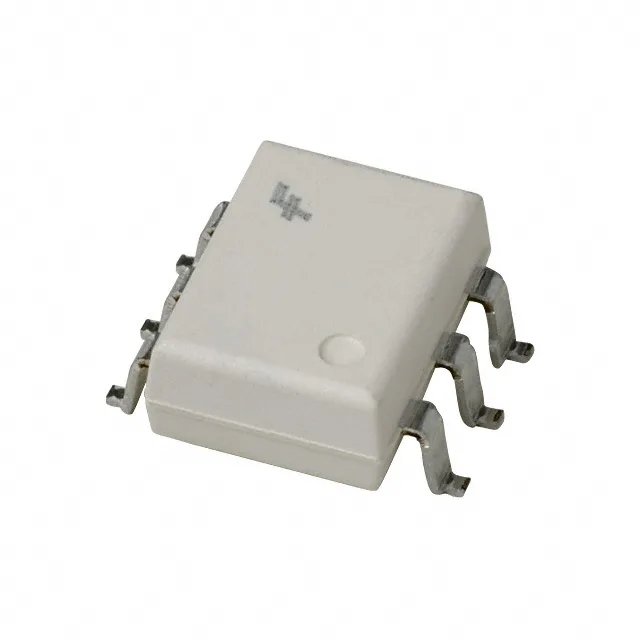
Darlington gain for low-drive BOMs
The 4N32SR2M delivers a minimum current transfer ratio of 500% at 10 mA forward current, meaning a 10 mA LED input can saturate the output Darlington pair to drive up to 50 mA without additional transistor stages. This gain margin lets you use a lower-value series resistor on the LED side, saving board space and reducing thermal load in dense PLC or relay-driver cards.
4170 Vrms isolation and 150 mA output ceiling
Rated for 4170 Vrms isolation, this part meets reinforced insulation requirements for 230 VAC mains in industrial control and motor-drive applications. The output Darlington can sink up to 150 mA continuous with a maximum Vce saturation of 1 V, which keeps power dissipation low enough for the 6-SMD gull-wing package without a heatsink.
Switching speed limits PWM use
Turn-on time is 5 µs typical, but turn-off time can reach 100 µs maximum. That asymmetry means the output may not fully turn off between pulses above about 5 kHz switching frequency. For low-speed digital isolation — think 24 VDC sensor inputs, relay coil drives, or AC mains zero-cross detection — the speed is adequate. For PWM motor control above a few kilohertz, a transistor-output optoisolator like the 4N38SM with 5 µs turn-off is a better fit.
Surface-mount assembly and rework
The gull-wing leads are reworkable with hot air without damaging adjacent components — a practical advantage over leadless packages in prototype or low-volume production.
onsemi lists the 4N32SR2M as Active and fully RoHS3 compliant.