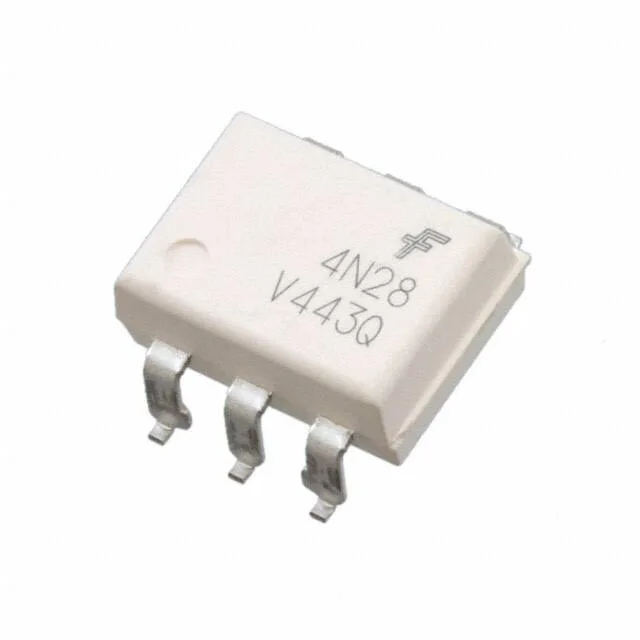
Isolation and switching – what the ratings drive
Rated for 4170 Vrms isolation – this is the withstand voltage between input LED and output phototransistor. It suits galvanic isolation in off-line power supplies, motor-drive feedback, and industrial PLC I/O modules where a transient surge could otherwise couple through to the logic side. Minimum current transfer ratio is 10% at If = 10 mA. That means with 10 mA through the LED, the output transistor can sink at least 1 mA of collector current. For a 5 V logic input, a 4.7 kΩ pull-up resistor on the collector gives a clean logic-low; the CTR floor guarantees saturation across temperature and LED ageing. Turn-on and turn-off times are both 2 µs typical. That caps the usable data rate at roughly 250 kbps for non-return-to-zero signalling – fine for 115.2 kbps UART isolation or low-speed PWM gate drive, but not for high-speed CAN or Ethernet isolation.
Temperature range and package – board-fit notes
The upper limit is 100°C, not the 125°C common on automotive optoisolators – so this part fits industrial enclosures and outdoor telecom cabinets, but not under-hood engine electronics. Housed in a 6-SMD gull-wing package. The gull-wing leads are visible for solder-joint inspection and rework-friendly with a hot-air station. The 6-SMD footprint is shared with the 4N25 and 4N37 families, making it a drop-in swap if the CTR or Vce(sat) specs align with the application.