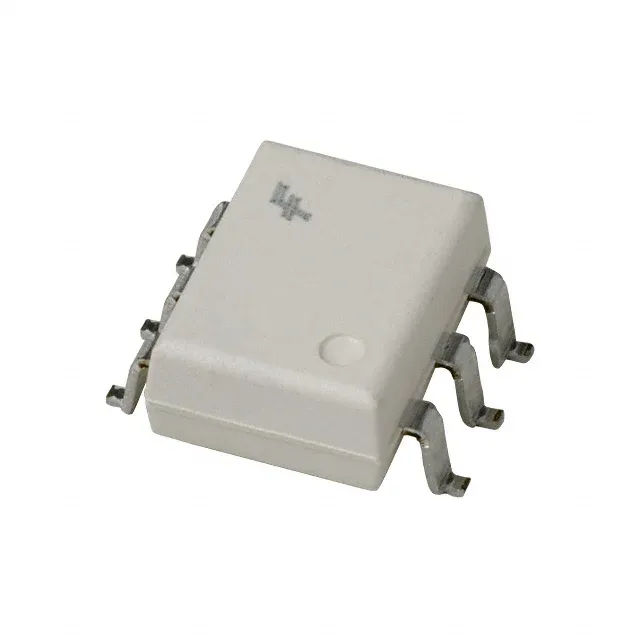
The 4N28FR2M is officially obsolete per onsemi's lifecycle status. Sourced to order against RFQ through independent distribution channels.
7500Vpk isolation — 1-channel phototransistor with base access
Rated for 7500Vpk isolation voltage, this part provides reinforced galvanic isolation between a DC input (IR LED) and a phototransistor output with the base brought out to a separate pin. The base-access pin allows the designer to bias the transistor for faster switching or to implement a Darlington pair externally. Minimum current transfer ratio (CTR) is 10% at 10 mA forward current — this sets the LED drive current needed to guarantee a given collector current at the output. The 60 mA absolute-maximum forward current limits the LED drive in high-temperature or high-CMR designs. Switching times are 2 µs typical for both turn-on and turn-off at the stated test conditions. This places the 4N28FR2M in the medium-speed class for optocouplers — adequate for 50/60 Hz line sensing, relay drivers, and logic-level translation below 100 kHz, but not for high-speed digital isolation.
-55°C to 100°C — full industrial temperature range
The 30V maximum collector-emitter voltage on the output side suits 24V logic rails with margin for transients. Vce saturation is 500 mV maximum at the test current — this is the voltage drop across the output transistor when fully on. In a typical 5V logic interface, the 500 mV drop leaves 4.5V at the receiver input, well above the 2.0V VIH threshold for TTL or 3.3V CMOS.
6-SMD gull wing — surface-mount assembly
Packaged in a 6-SMD gull-wing surface-mount case (supplier device package 6-SMD). Supplied on Tape & Reel (TR) for automated pick-and-place assembly. The 1.18V typical forward voltage at 10 mA is the LED drop — design the series resistor for this value at the target forward current.