Isolation and signal transfer — what the ratings mean
The 4N28300W: Rated for 5300Vrms isolation, this optoisolator provides galvanic separation between the DC input and the transistor output side, suitable for applications requiring reinforced insulation per IEC 60950 or similar standards. Minimum current transfer ratio (CTR) is 10% at 10 mA forward current. This means the output transistor can sink at least 1 mA when the input LED is driven with 10 mA. For reliable operation, the input drive must be designed to guarantee this minimum CTR across temperature and LED aging. Typical turn-on and turn-off times are 2 µs each. This sets the practical switching frequency ceiling around 250 kHz for square-wave signals, though the actual limit depends on load resistance and collector capacitance.
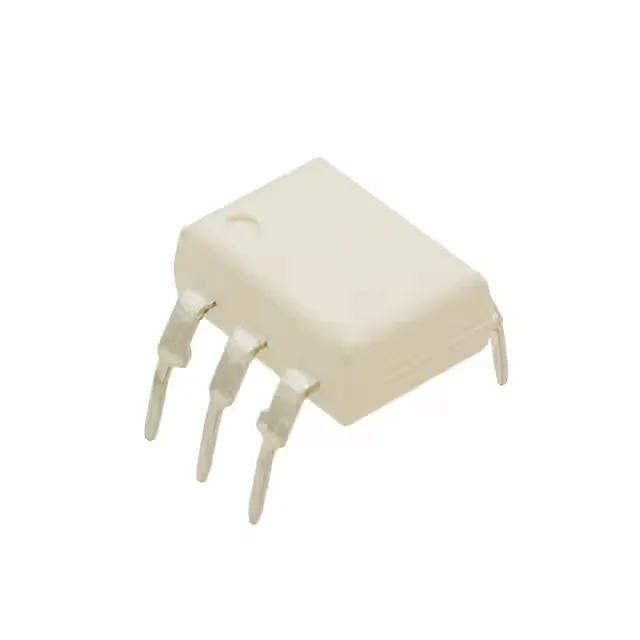
Housed in a 6-DIP through-hole package with 0.400-inch (10.16 mm) row spacing and a standard 0.100-inch pin pitch. The supplier device package is 6-DIP; the footprint is identical to the industry-standard 6-pin DIP optocoupler layout. Mounting is through-hole only — no surface-mount variant is listed for this order code. The tube packaging is the standard shipping medium for DIP devices.
Temperature range and output ratings
The maximum output voltage is 30 V, and the Vce saturation voltage is 500 mV maximum at rated drive. Maximum DC forward current through the input LED is 100 mA, with a typical forward voltage of 1.18 V at nominal drive. The output is a phototransistor with the base terminal brought out, allowing external bias or speed-up networks.