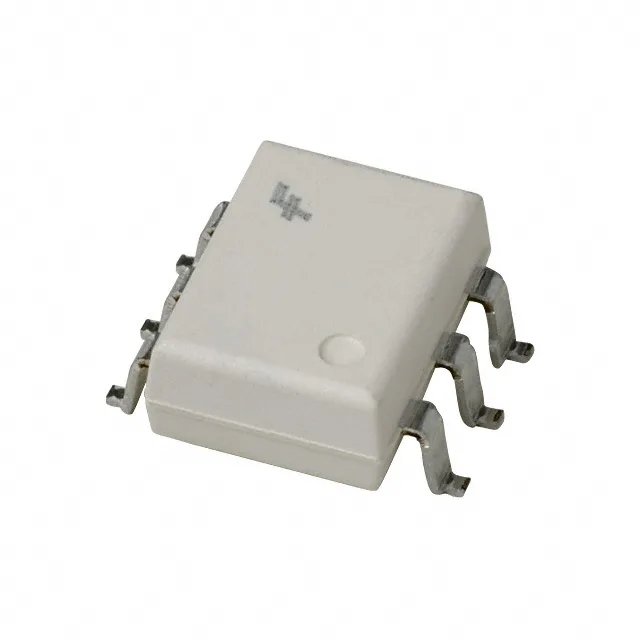
What does this optocoupler do and where does it fit?
The onsemi 4N25SVM is a single-channel optocoupler that isolates a DC input from a transistor output. It provides 4170 Vrms of galvanic isolation between the input LED and the output phototransistor, which means signals or control lines on one side of the barrier are electrically isolated from the other — essential for protecting low-voltage logic from high-voltage transients or ground loops in industrial and power-supply circuits. The output is a phototransistor with the base brought out to a pin (pin 6), giving you the option to bias the base for faster switching or to connect a feedback resistor for improved linearity. The typical turn-on and turn-off times are both 2 µs, which suits moderate-speed isolation applications like PLC digital inputs, motor-drive feedback, or AC mains zero-cross detection.
The minimum current transfer ratio (CTR) is 20% at a forward current of 10 mA. This means that with 10 mA through the LED, the phototransistor can sink at least 2 mA (20% of 10 mA) at the output. For a typical 5 V logic input, a 2.2 kΩ pull-up resistor on the collector gives a clean logic-low — the CTR tells you the LED drive current needed to guarantee the output saturates. The maximum collector-emitter voltage is 30 V, and the maximum forward current through the LED is 60 mA. The 30 V output ceiling is typical for 5 V or 12 V logic rails; if you need to switch 24 V industrial signals, this part still works as long as the collector voltage stays under 30 V. The 60 mA LED limit means the LED can be driven directly from a microcontroller GPIO with a series resistor, though the 10 mA test condition is the sweet spot for guaranteed CTR. Operating temperature spans -40°C to 100°C, covering industrial enclosures and outdoor telecom cabinets. The Vce saturation is 500 mV max at the rated drive — the transistor pulls low to within half a volt of ground, which is clean enough for most logic families.
Lifecycle reality — obsolete, but still sourced
onsemi lists the 4N25SVM as obsolete. This means the manufacturer no longer produces it, and no official successor part number is published.