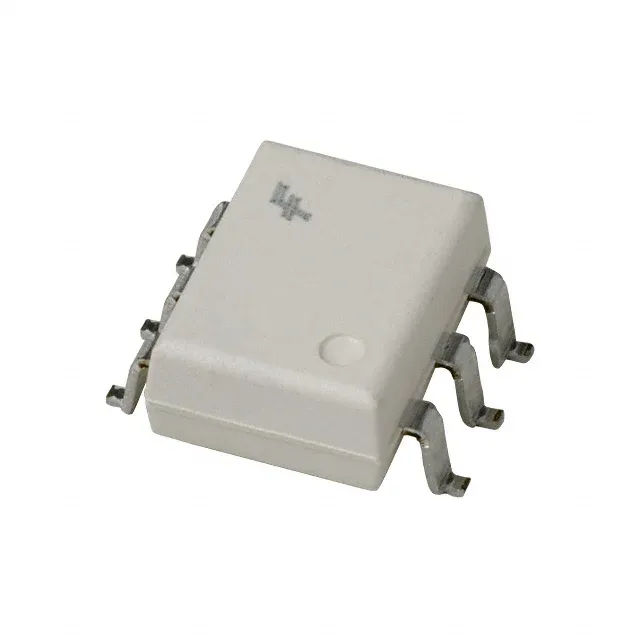
5300Vrms isolation barrier — the safety spec that drives the BOM
The 4N253S: That isolation rating qualifies it for reinforced insulation in mains-connected circuits — think AC-DC power supplies, motor drive feedback paths, and medical equipment where the safety barrier must withstand 250V continuous working voltage plus transients. The 20% minimum current transfer ratio at 10mA forward current means the output transistor needs at least 2mA collector current to guarantee the logic state — a 10kΩ pull-up to 5V delivers that margin. Below that CTR floor, the output may not saturate cleanly, so the LED drive current must be sized for the worst-case 20% CTR, not the typical value. Switching is rated at 2µs turn-on and 2µs turn-off typical, which limits the practical data rate to about 250 kbps in a standard phototransistor configuration. For higher-speed isolation, a logic-output optocoupler would be needed, but for 50/60 Hz zero-crossing detection, relay driver isolation, or slow PLC input debouncing, this response time is adequate.
onsemi lists the 4N253S as Obsolete. No official successor part number is published. The part is no longer manufactured and is not available through the standard authorized distribution channel. Sourcing is through independent surplus and broker inventory — quantities are lot-specific, and full traceability is confirmed at RFQ. For a BOM that already qualifies the 4N253S, the pin-compatible drop-in from the same 4N25 family (e.g. 4N25, 4N26, 4N27) shares the same 6-SMD Gull Wing footprint and 5300Vrms isolation, but CTR and Vce(sat) specs differ — verify the minimum CTR against the circuit's LED drive current before substituting.
6-SMD Gull Wing — board-fit and temperature range
The 6-SMD Gull Wing package (supplier device package 6-SMD) is a surface-mount footprint with a 1.27 mm pitch typical for SOIC-6 wide-body optocouplers. The gull-wing leads provide visual solder-joint inspection access and moderate board-level stress relief. The tube packaging means the parts are shipped in anti-static tubes, not tape-and-reel — factor this into pick-and-place feeder setup if the line expects reeled parts. Operating temperature spans -55°C to 100°C, covering industrial enclosures, outdoor telecom cabinets, and some military-grade environments. The 100 mA absolute maximum forward current on the LED side gives headroom for pulsed drive schemes, but continuous operation should stay well below that to avoid LED degradation over the product lifetime.