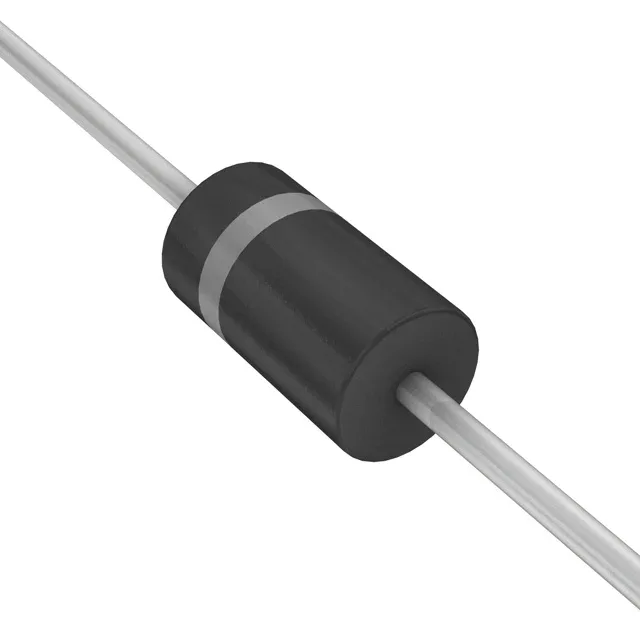
What this Zener TVS is and why it matters
The 1N6294AG: The reverse standoff voltage and minimum breakdown set the protection threshold; the clamping level at Ipp defines the maximum voltage the downstream circuit sees during a transient. This part is intended for general-purpose transient suppression on power rails and signal lines.
onsemi lists the 1N6294AG as Obsolete. For BOM lines that still call out this exact order code, the only sourcing path is through independent or secondary-market distributors who carry surplus, NOS (new old stock), or pulled inventory. We can source the 1N6294AG against your BOM quantity and date-code requirements.
The minimum breakdown voltage is where the diode starts to avalanche; below this the circuit sees no clamping. The wider the gap between standoff and clamping, the more headroom the downstream components need.
The axial package is a through-hole form factor with two leads. It is typically mounted by inserting the leads into plated through-holes and soldering on the opposite side. The axial lead allows the diode to be placed inline with the trace, which is common for transient suppression on power inputs or bus lines. No power line protection feature is included — this is a basic Zener TVS, not a combination protector.