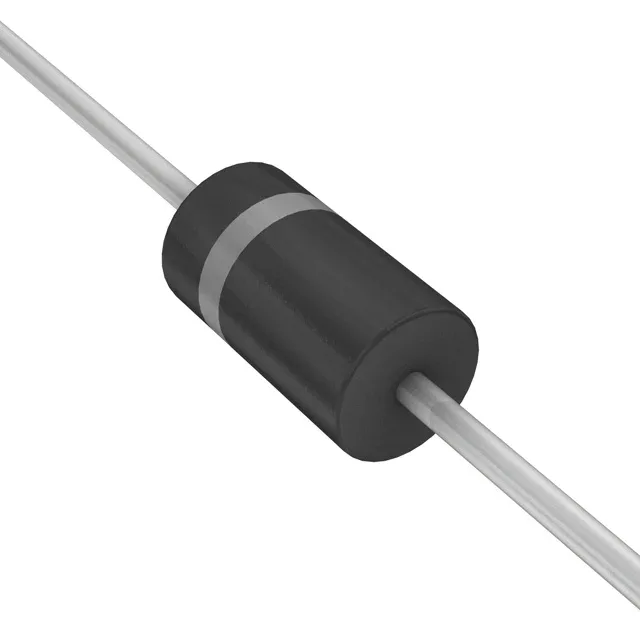
Zener TVS — 1500 W surge clamp in an axial lead
The 1N6289ARL4 is an onsemi Mosorb™ Zener TVS diode designed to clamp transient overvoltages on a 47.8 V nominal rail.
onsemi lists the 1N6289ARL4 as Obsolete.
Breakdown voltage and clamping performance
The reverse standoff voltage is 47.8 V — the rail voltage below which the diode does not conduct leakage. This is a unidirectional device, so it protects one polarity; for AC or bidirectional rails you would need two parts or a bidirectional TVS.
The DO-201AD axial package is a through-hole form factor with two leads exiting opposite ends of the body. The 0.050-inch lead diameter and 1.0-inch body length are standard for this power class; the hole diameter and pad spacing on the PCB must match the lead span. Through-hole mounting gives a robust mechanical anchor for high-vibration environments, but it adds an assembly step compared to surface-mount TVS diodes. The supplier device package is Axial — no special heatsink is required for the 1500 W pulse rating, but the board copper area around the lead pads helps conduct heat from repetitive surges.