Core and speed — what 1.0 GHz buys you
The MCIMX6L2DVN10AB: This is a single-core ARM Cortex-A9 running at 1.0 GHz, a 32-bit application processor aimed at human-machine interfaces, point-of-sale terminals, and connected display systems where the balance of performance to power matters more than raw throughput. The NEON SIMD coprocessor handles multimedia vector operations in hardware — think pixel processing, audio filtering, or basic image transforms — without loading the core. Graphics acceleration is on-die, so the LCD controller can drive a display without an external GPU for typical 2D UI workloads.
Memory interface — which DRAM types it talks to
The memory controller supports LPDDR2, LVDDR3, and DDR3 — three DRAM families covering low-power portable designs through standard DDR3 modules. This flexibility means the same MPU can serve a battery-powered tablet (LPDDR2) and a mains-powered kiosk (DDR3) with only a memory-device change, not a processor spin.
Package and board-fit — 432-MAPBGA
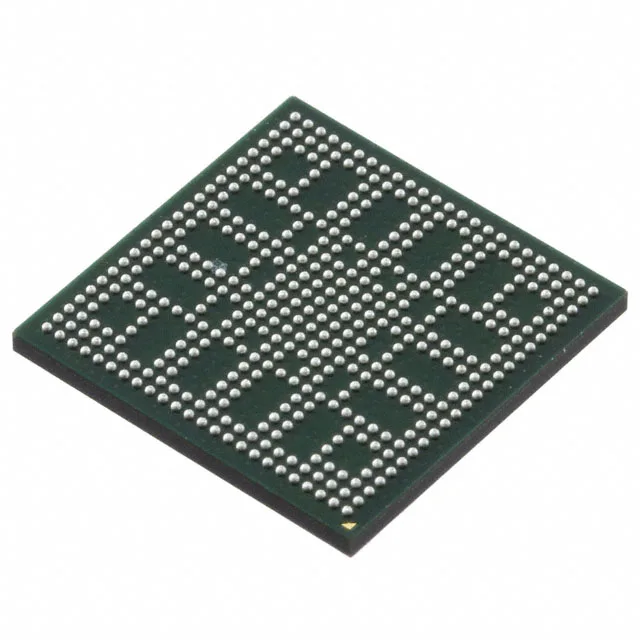
Housed in a 432-ball MAPBGA, 13x13 mm body — the 0.50 mm ball pitch is standard for this density and routes cleanly on a 4-layer board with microvias. The supplier device package is 432-MAPBGA (13x13), surface-mount only. No socketed or through-hole variant exists for this part.
Temperature grade — 0°C to 95°C junction
Rated for 0°C to 95°C junction temperature — this is a commercial/industrial grade, not automotive. It fits indoor equipment, kiosks, and climate-controlled enclosures, but not under-hood or outdoor direct-sun deployments.
Peripheral set — USB, Ethernet, and serial interfaces
Three USB 2.0 ports with integrated PHY — each port is a complete physical-layer interface, so no external transceiver is needed for host or OTG operation. One 10/100 Mbps Ethernet MAC with dedicated MII/RMII interface — the PHY is external, but the MAC handles the protocol stack in hardware. Additional serial interfaces include AC97, I²C, I²S, MMC/SD/SDIO, SPI, SSI, and UART — covering audio codecs, touch controllers, wireless modules, and storage.
Security features — hardware root of trust
The security subsystem includes ARM TrustZone, boot security, cryptography acceleration, a secure fuse box, secure JTAG, secure memory, secure RTC, and tamper detection — enough to run a secure boot chain and encrypt data at rest without a separate secure element.