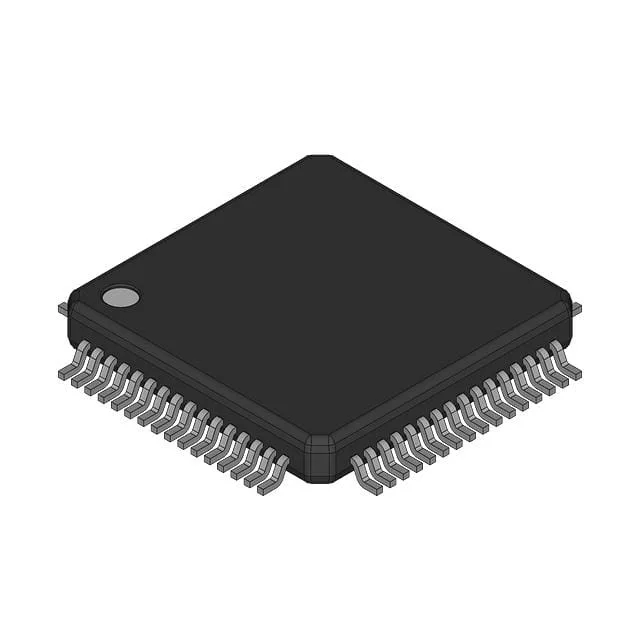
Device identity and core parametrics
The MC9S08GW64CLH: The 16-channel, 16-bit A/D converter is the standout analog peripheral here — it resolves down to about 15 µV per LSB at a 1.8 V reference, which is useful for direct sensor readout without an external ADC. The LCD controller can drive segmented glass panels directly, saving a separate driver chip in metering or display applications.
Package, temperature, and supply — the board-fit details
The pad layout is straightforward for a 4-layer board; the 0.5 mm pitch means you'll want a soldermask-defined pad and a 0.25 mm stencil aperture for a clean reflow. Pin 1 is clearly marked with a chamfer on the package corner, so orientation is unambiguous under a microscope. The operating temperature range spans -40°C to 85°C, which covers industrial control cabinets and outdoor telecom enclosures. With 57 general-purpose I/O lines, there is enough pinout for a parallel LCD data bus, a row of pushbuttons, and a few status LEDs while still leaving serial interfaces free. The internal oscillator means you can skip an external crystal for many applications, though the accuracy will drift with temperature — keep that in mind if you need a precise timebase.
Peripheral set and connectivity
The MC9S08GW64CLH carries I²C, LINbus, SCI (UART), and SPI interfaces, covering the common serial buses for sensor aggregation and actuator control in an automotive or industrial node. The LINbus interface is a plus for body-electronics modules that need to talk on a single-wire bus. On the timing side, there is a PWM module for motor or LED dimming control and a watchdog timer (WDT) for system supervision. The LCD peripheral handles up to a certain segment count — check the reference manual for the exact segment mapping, but it is enough for a 4-digit 7-segment display or a custom icon-based glass.