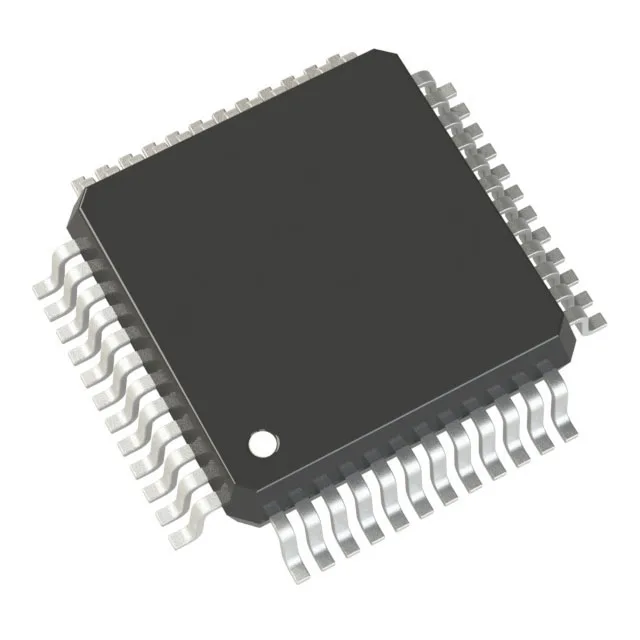
FS32K144WAT0WLFT

NXP Semiconductors · S32K Series

NXP S32K series ARM Cortex-M4F MCU, FS32K144WAT0WLFT, 80 MHz, 512KB Flash, 64KB RAM, 4KB EEPROM, 48-LQFP, -40 to 150°C, ROHS3.

NXP Semiconductors FS32K144WAT0WLFT
Download datasheet (PDF)
[IN STOCK] In Stock: 5 pcs
$14.41/ pc

Volume pricing

Buy Now

MOQ 1 · Tray · RoHS · EIA-481 · DAP/DDP · T/T

Technical specifications

FS32K144WAT0WLFT specifications
Parameter / AttributeSpecification / Value
SeriesS32K
MountingSurface Mount
Oscillator typeInternal
Program memory typeFLASH
Voltage - supply (Vcc (Vdd))3.13V ~ 5.5V
Operating temperature-40°C ~ 150°C (TA)
Speed80MHz
PackageTray
RAM size64K x 8
Core size32-Bit Single-Core
EEPROM size4K x 8
PeripheralsPOR, PWM, WDT
ConnectivityCANbus, FlexIO, I²C, LINbus, SPI, UART/USART
Number of i (O)43
Core processorARM® Cortex®-M4F
Case48-LQFP
Data convertersA/D 23x12b SAR; D/A 1x8b
Program memory size512KB (512K x 8)
100% Footprint Match · Solder-Ready (No PCB Redesign Needed)

Need Stock or a Drop-in Second-Source for FS32K144WAT0WLFT?

Package: LQFP-100 / LQFP-64 / LQFP-144 · Pin-compatible replacements with immediate Shenzhen spot stock

Footprint Match 98%
Supply Chain & Allocation Reality:

The S32K144 is the automotive and industrial workhorse of NXP current MCU line: Cortex-M4F to 112MHz, AEC-Q100, ASIL-B capable, with a 15-year longevity commitment that keeps the whole S32K1 platform in bills of materials decade-style. The family comes with a rare gift for sourcing: NXP states that all devices sharing a common package are pin-to-pin compatible, so the S32K142/144/146/148 are a genuine ladder - same socket, scaled flash, RAM and peripherals. What that means in practice: a line-down shortage on one flash grade can be bridged with another grade in the same package, with the firmware built for the smaller part.

Verified Pin-Compatible Replacements (2 verified alternatives)

S32K142 NXP Semiconductors LQFP-100 / LQFP-64
100% Drop-in (Zero Code Change)
Availability & Target Pricing:

One Grade Down, Same Socket

Shenzhen Spot Stock (24-48h Dispatch)

Electrical & Core Specs:

The 256KB-flash member (32KB SRAM): same Cortex-M4F core to 112MHz, same peripheral architecture, fewer FlexCAN and I/O instances by package.

Single 2.7V to 5.5V supply and -40 to +125/150C grades across the family.

Compatibility & Drop-In Notes: The firmware decides the direction: build for the smaller member and any larger-grade part in the same package runs it; a binary that already outgrew the smaller flash cannot shrink back into it. For shortage bridging, confirm the image fits before promising the swap.
Package & Solder Footprint: Common packages are pin-to-pin per NXPs own datasheet statement - the 100-pin LQFP is the shared center of the family.
Shenzhen Warehouse Stock & MOQ: Stocked across the ladder for exactly this kind of bridging.
S32K146 NXP Semiconductors LQFP-100 / LQFP-144
100% Drop-in (Zero Code Change)
Availability & Target Pricing:

One Grade Up

Shenzhen Spot Stock (24-48h Dispatch)

Electrical & Core Specs:

512KB to 1MB flash class (S32K146 at 1MB with 128KB SRAM): more FlexCAN, QuadSPI, ENET and trace features appearing as the ladder rises.

Same supply and temperature envelope - the family scales memory and peripherals, not the electrical interface.

Compatibility & Drop-In Notes: Upward moves are the comfortable direction of this family: same package, more headroom, existing firmware runs. Re-check the oscillators and clock tree as with any MCU grade change, and keep one lot per build.
Package & Solder Footprint: Pin-to-pin in shared packages; features not present on the smaller part appear as extra pins only in packages the smaller part never shipped in.
Shenzhen Warehouse Stock & MOQ: Stocked with date-code documentation for automotive documentation chains.
Buyer & Quality Checklist for Sourcing Alternatives
  • The family rule is official and rare: within S32K1, all devices sharing a package are pin-to-pin compatible - verify the package first, then the flash grade. This is the shortage-bridging playbook.
  • Direction matters: larger-grade parts run firmware built for smaller members; the reverse fails at link time, not on the bench. Confirm the image size before substituting downward.
  • Re-check the clock tree and the CSEc security configuration after any grade change - automotive designs carry these settings as part of the software delivery, not the silicon.
  • AEC-Q100 grade and the temperature suffix are part of the orderable number: an industrial-grade equivalent does not serve an automotive certificate. Grade for grade.
  • Longevity is the reason this family is sourcable decades out: NXP backs the platform with a 15-year program - expect the spot market to carry it long-term, and expect relabeling of grades within it. Date codes and documentation before dispatch.
  • For production, hold one grade and one lot: automotive flash often carries synchronized configuration (CSEc keys, trim) that changes with lot handling, not just silicon.
Frequently Asked Technical Questions

Q: Are S32K142, S32K144 and S32K146 interchangeable?

A: In the same package, yes - NXP documents that all S32K1 devices sharing a package are pin-to-pin compatible. The differences are flash, RAM, peripheral counts and connectivity; firmware built for the smaller member runs on the larger, not the reverse.

Q: Can I bridge an S32K144 shortage with another S32K1 grade?

A: That is the family design intent: same-package grades are socket-compatible. Confirm the firmware image fits the substitute grade, re-check clock and security configuration, and keep the automotive grade and temperature suffix matched to the certificate.

Q: What is the S32K3 comparison?

A: S32K3 is the next-generation platform - a design migration with new tooling and safety architecture, not a grade change. Within S32K1 the ladder is the substitution story; across generations it is a project.

Technical details

Core compute and memory budget

The FS32K144WAT0WLFT: The ARM Cortex-M4F core runs at 80 MHz with a single-precision FPU — the floating-point unit handles sensor fusion or motor-control math without software emulation overhead. On-chip memory includes 512 KB of Flash for application code, 64 KB of SRAM for runtime data, and 4 KB of EEPROM for calibration parameters or fault logs that survive power loss.

Automotive temperature and supply range

Supply voltage spans 3.13 V to 5.5 V, allowing direct connection to a 5 V automotive bus without an external regulator in many designs.

Peripheral set and I/O

43 general-purpose I/O lines are available; the connectivity block includes CANbus, LINbus, I²C, SPI, UART/USART, and FlexIO — enough to handle a body controller gateway or a multi-sensor node. On-chip data converters: a 23-channel 12-bit SAR ADC and a single 8-bit DAC. The ADC samples up to 23 analog inputs without external muxing.

FS32K144WAT0WLFT
[ALLOC] verified
Quote