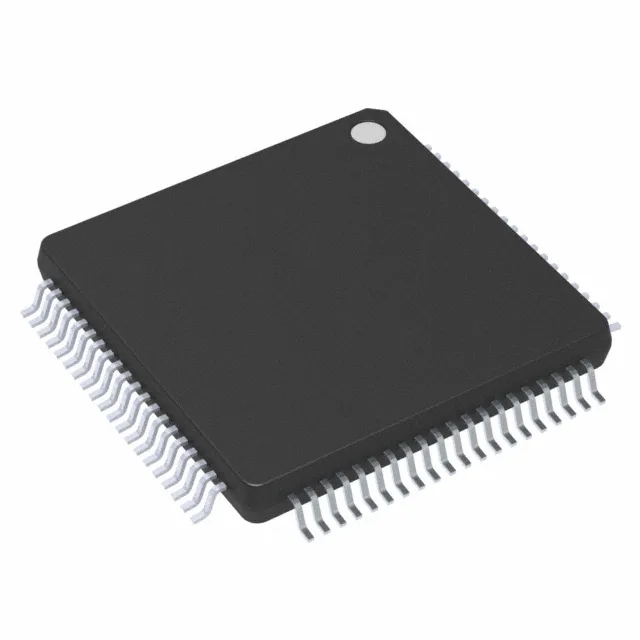
NXP Kinetis K20, ARM Cortex-M4 100MHz single-core, 512KB Flash, 128KB RAM, 27x16b ADC, CANbus, USB OTG, 80-FQFP (12x12mm), -40 to 105°C, 1.71 to 3.6V, ROHS3.
- 100% new & originalTraceable channels only — no refurbs, no pulls, no remarked parts.
- Date & lot codes on quoteStated per line before you commit; label photos on request.
- MSL-compliant ESD packingMoisture-sealed bags with indicator cards; reels photo-verified.
- PayPal buyer protectionPay by T/T, PayPal or Payoneer — card payments covered end to end.
Specifications
| Parameter | Value |
|---|---|
| Series | Kinetis K20 |
| Mounting type | Surface Mount |
| Oscillator type | Internal |
| Program memory type | FLASH |
| Voltage - supply (Vcc (Vdd)) | 1.71V ~ 3.6V |
| Operating temperature | -40°C ~ 105°C (TA) |
| Speed | 100MHz |
| Package | Tray |
| RAM size | 128K x 8 |
| Core size | 32-Bit Single-Core |
| Peripherals | DMA, I²S, LVD, POR, PWM, WDT |
| Connectivity | CANbus, EBI/EMI, I²C, IrDA, SD, SPI, UART/USART, USB, USB OTG |
| Number of i (O) | 52 |
| Core processor | ARM® Cortex®-M4 |
| Case | 80-LQFP |
| Data converters | A/D 27x16b; D/A 1x12b |
| Program memory size | 512KB (512K x 8) |
Frequently asked questions
What is the thermal margin for this MCU in a sealed industrial enclosure?
The rated maximum is 105°C ambient. At 85°C enclosure temperature, 20°C of margin remains. Thermal vias under the package paddle and board-level thermal resistance modelling determine whether passive cooling is sufficient for your continuous 100MHz load profile.
The LVD is throwing faults on our conveyor PLC module — is the MK20DN512VLK10 failing?
The LVD flags a supply brownout condition, which is expected behaviour when Vcc drops below the programmed threshold. Persistent LVD faults indicate an upstream supply problem, not a fault in the MCU. The POR block resets the part cleanly on power-up; verify the 3.3V rail stability at the MCU pins under load.
Does the MK20DN512VLK10 support USB OTG and CANbus simultaneously?
Yes — both peripherals are present on-die. USB OTG supports USB 2.0 full-speed operation; CANbus supports standard CAN 2.0A/B frame formats. They share no internal resources beyond the core bus matrix, so both can operate concurrently in a typical PLC or sensor gateway design.