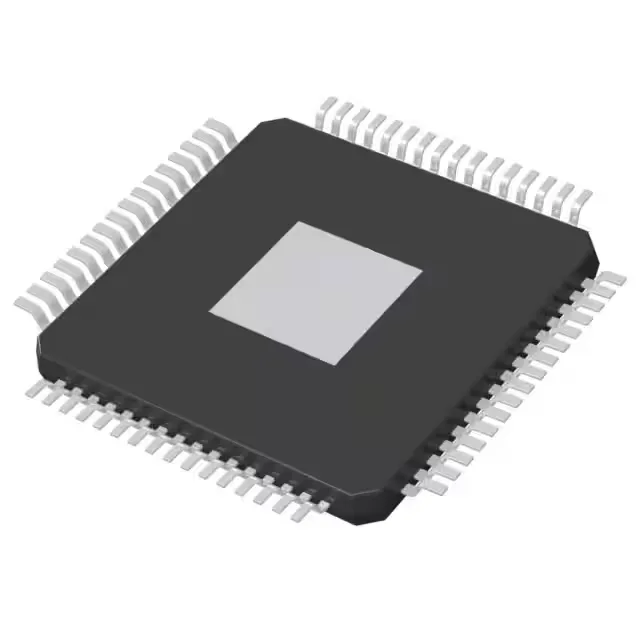
The LPC55S69JBD64K runs a single ARM Cortex-M33 core at 150 MHz. That clock rate puts it in the sweet spot for a motor-drive current loop or a Modbus TCP gateway where you need deterministic response without the power budget of a dual-core part. The 320 KB RAM gives the FreeRTOS heap and a TCP/IP buffer room to breathe; the 640 KB Flash holds a modest application stack with room for a bootloader and a field-update slot.
Industrial temperature range — rated for the factory floor
Rated -40 to 105 °C, so it lives in an outdoor telecom cabinet or a motor-drive enclosure without derating drama. The 64-HTQFP exposed-pad package (10x10 mm) pulls heat into the PCB copper pour — make sure the thermal vias under the pad connect to a solid ground plane. The 36 GPIO count is tight for a panel with a lot of local I/O; plan on a port expander or a serial shift register if you need more than a handful of discrete inputs.
Peripheral set — what the PWM and Flexcomm actually buy you
The PWM and DMA channels handle the time-critical work — a three-phase motor drive or a buck converter loop — while the Flexcomm interface reconfigures as I²C, SPI, or UART without changing the pinout. That flexibility saves a board spin if the comms protocol changes mid-project. The 10-channel 16-bit ADC is enough for six current-sense resistors plus a couple of voltage monitors; for more channels you'd step up to the LPC55S6x family's larger packages.
Listed as Active on the manufacturer's status — no last-time-buy deadline to chase. For dual-sourcing resilience, the LPC55S6x family shares the same footprint across density options, so a swap to a sibling with more Flash or RAM is a BOM-line change, not a board respin.