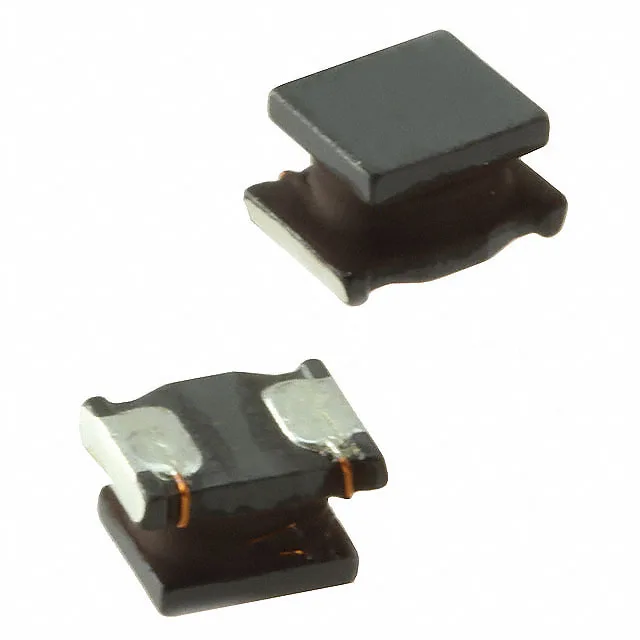
10 µH unshielded — what the ratings mean for the BOM
The LQH43NN100J03L: This is a 10 µH drum-core wirewound inductor with a ±5% tolerance, tested at 1 MHz. The 400 mA current rating is the DC current at which the inductance typically drops by 10% due to core saturation — for a 350 mA rail, you have margin; at 400 mA continuous, expect the inductance to sag below 9 µH. The 560 mOhm maximum DC resistance sets the copper loss: at 400 mA, I²R dissipation is 89.6 mW. Self-resonant frequency is 23 MHz. Above that frequency, the inductor behaves capacitively — for a switching regulator switching at 2 MHz, the SRF is well clear, but a 10 MHz noise filter on this part would see the impedance roll off. It matters for tuned circuits (resonant tank, impedance matching) more than for power filtering, where DCR dominates the loss.
Unshielded — plan the PCB layout accordingly
The unshielded construction means the magnetic field radiates from the drum core. Adjacent traces carrying sensitive analog signals or high-impedance nodes should be kept at least one package width (4.5 mm) away to avoid coupling. A shielded inductor in the same 1812 footprint is a drop-in swap if radiated noise becomes a problem during EMC testing. Package is 1812 (4532 metric), 4.50 mm x 3.20 mm, seated height 2.80 mm max.