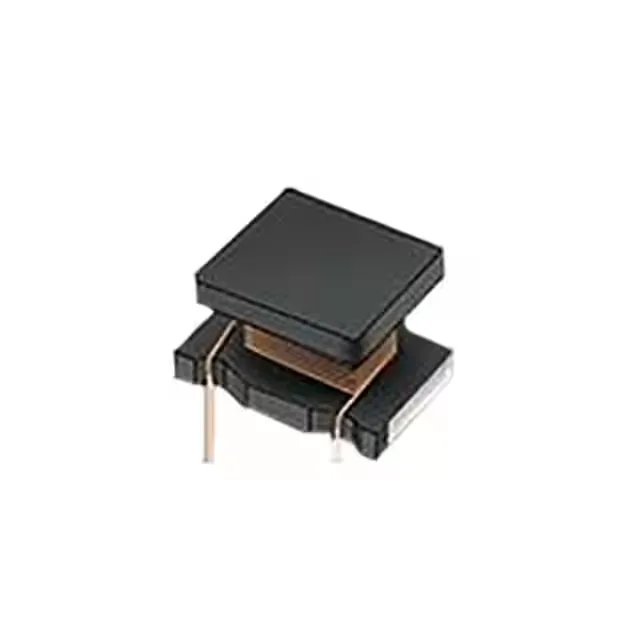
100 µH at 80 mA — the DC bias limit that governs the filter
The Murata LQH32NZ101J23L is a 100 µH drum core wirewound inductor from the LQH32 series, qualified to AEC-Q200 for automotive-grade reliability. The 80 mA current rating is the DC bias limit at which the inductance drops by a defined percentage — exceeding it saturates the ferrite core and the inductor behaves like a short, so the filter or DC-DC converter loses regulation. The 7 Ohm max DC resistance (DCR) sets the I²R loss at full rated current: at 80 mA the self-heating is roughly 45 mW, negligible in most circuits, but the DCR also adds a voltage drop that matters in low-voltage rails. The 8 MHz self-resonant frequency (SRF) means the inductor behaves inductively up to that point — above it the parasitic capacitance dominates and the impedance drops, so this part suits switching frequencies well below 8 MHz, typically in EMI filtering or low-frequency DC-DC input/output stages.
AEC-Q200 and the 105 °C ceiling
This covers under-hood and cabin environments where the ambient temperature stays below 105 °C — an engine control unit or transmission module that sees 85 °C on a hot day still has 20 °C margin before the ferrite core's Curie temperature becomes a risk. The Q factor of 40 at 796 kHz tells you the ratio of stored energy to dissipated energy at that test frequency — a higher Q means sharper resonance and lower losses in tuned circuits, but for a power or filtering application the DCR and SRF are the dominant selection parameters. The ±5% tolerance keeps the inductance value tight across the reel, which matters when multiple inductors share a common bias point in a multi-phase converter or a filter bank.
1210 footprint and the board-level fit
The unshielded construction means the magnetic field radiates from the drum core; adjacent traces carrying sensitive analog signals should be routed at least one package width away to avoid coupling. The ferrite core material gives stable inductance over temperature up to the 105 °C limit, but the unshielded design means the inductance shifts if a metal enclosure or chassis is placed within the near-field distance.