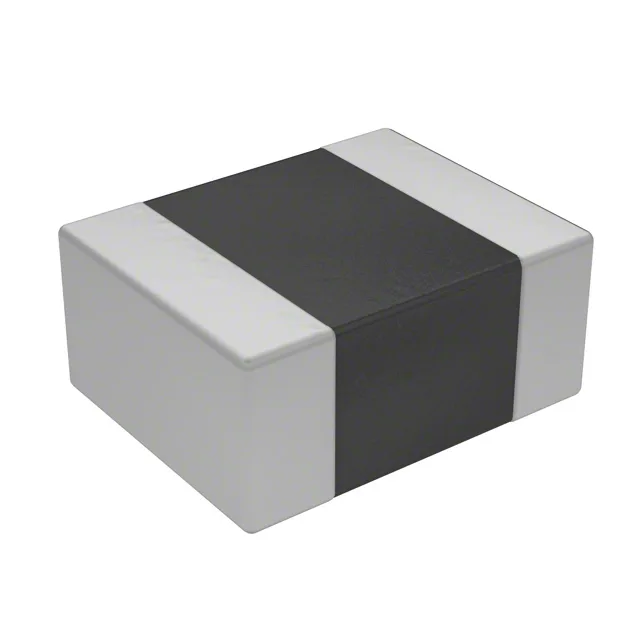
4.7 A rated, 6.3 A saturation — which ceiling governs your rail
The DFE201610E-R24M=P2 is a shielded wirewound inductor from Murata's DFE201610E series, built with a metal composite core. Its 240 nH ±20% inductance targets DC-DC converter output filters and power rail smoothing in space-constrained designs. Two current limits matter here: 4.7 A continuous rated current (heating-limited, based on the 20 mOhm max DCR temperature rise), and 6.3 A saturation current (Isat), where inductance drops by ~30% under DC bias. For a rail drawing 4 A steady with a 5.5 A transient, the saturation ceiling is the real constraint — the core saturates before the DCR temperature rise becomes critical.
0806 footprint, 1.0 mm profile — board-fit constraints
The low profile suits multi-layer PCB stacks where component clearance above the board is tight — think thin-profile power modules or handheld device power stages. Shielded construction (magnetic-resin coating) contains the flux field, so the inductor can sit adjacent to sensitive analog traces or RF sections without injecting switching noise into the signal path.
Metal composite core — why it matters for saturation behaviour
The metal composite (iron-alloy powder) core gives a soft-saturation characteristic — inductance rolls off gradually under DC bias rather than collapsing abruptly as it would with a ferrite core. This means the inductor still delivers some energy storage even above the Isat threshold, which can prevent catastrophic current runaway in a fault transient.