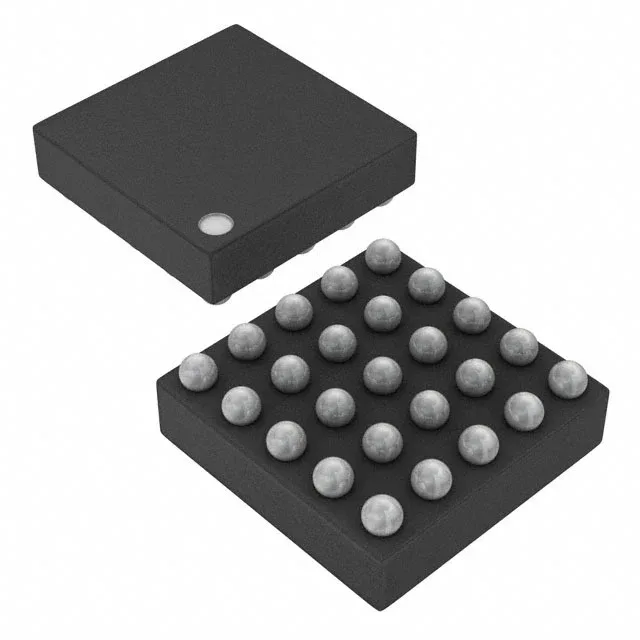
USB physical-layer interface in a WLCSP
The USB3322C-GL-TR is a half-duplex USB transceiver from Microchip Technology's flexPWR™ series, packing a single driver and single receiver into a 25-bump WLCSP that measures 1.97 mm square. With 150 mV of receiver hysteresis, it rejects noise on the USB differential pair — useful when the cable runs near a switching supply or motor drive inside the same enclosure.
WLCSP footprint and field-fit reality
The 25-WLCSP (1.97x1.97 mm) is a wafer-level chip-scale package — no molded body, just solder balls directly on the die. That means the PCB land pattern must match the ball pitch exactly; there is no room for a fan-out via between balls on a standard two-layer board. Surface-mount only, supplied on Tape & Reel (or Cut Tape for prototyping). The small footprint saves board space but demands a solder-paste stencil with the correct aperture for the ball diameter — a hand-solder swap in the field is not realistic without a reflow station.
Why the half-duplex matters for your USB bus
Half-duplex means the transceiver cannot transmit and receive simultaneously — it switches direction. For USB 1.x/2.0 low-speed and full-speed signaling this is standard; the host controller manages the turn-around. If your design expects full-duplex (like RS-422), this part will not work. The single driver and single receiver pair maps to one USB D+/D- differential pair. No extra channels for sideband signals — the protocol layer handles enumeration and handshaking.