Clamp voltage and standoff margin — what to watch
The 28.9 V minimum breakdown gives a ~2.9 V guard band above the standoff — enough to avoid false triggering from normal rail ripple or transients that stay within the operating envelope. The 42.1 V clamp at 35.6 A is the voltage the downstream circuitry must survive during a surge event; if your 24 V rail has a 40 V absolute max on the powered ICs, this diode leaves only 2.1 V of headroom under worst-case clamp, so confirm the load's avalanche margin.
Peak pulse power and junction temperature range
Rated 1.5 kW peak pulse power per the 10/1000 µs waveform — this is the standard telecom surge shape; for shorter pulses (8/20 µs) the peak power capability is higher. The junction temperature range spans -65°C to 150°C, covering automotive underhood, outdoor base-station enclosures, and industrial control cabinets where the ambient can exceed 85°C. Derate the peak pulse power above 25°C per the datasheet curve; at 150°C the derating factor typically reaches zero, so keep the operating junction below 125°C for repetitive events.
Active production and package availability
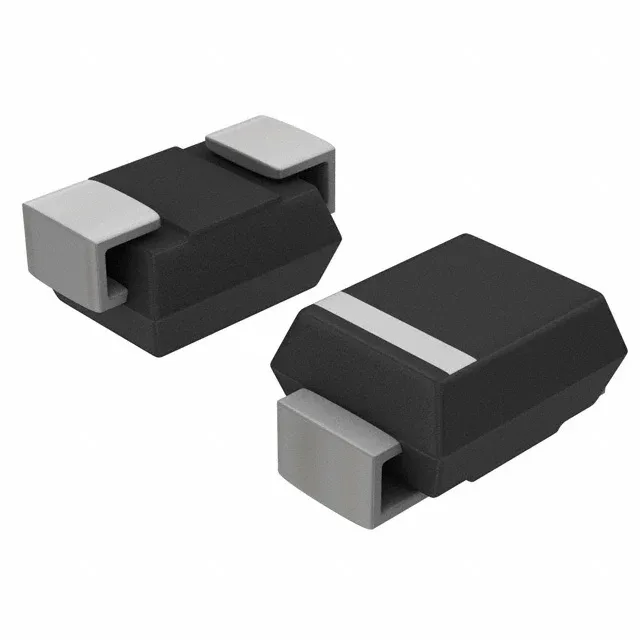
The DO-214AB (SMC) package is a standard JEDEC outline shared across the SMCJ family, so the footprint is interchangeable with other 1.5 kW SMC TVS diodes from Littelfuse, Vishay, or Bourns if a second-source is needed.