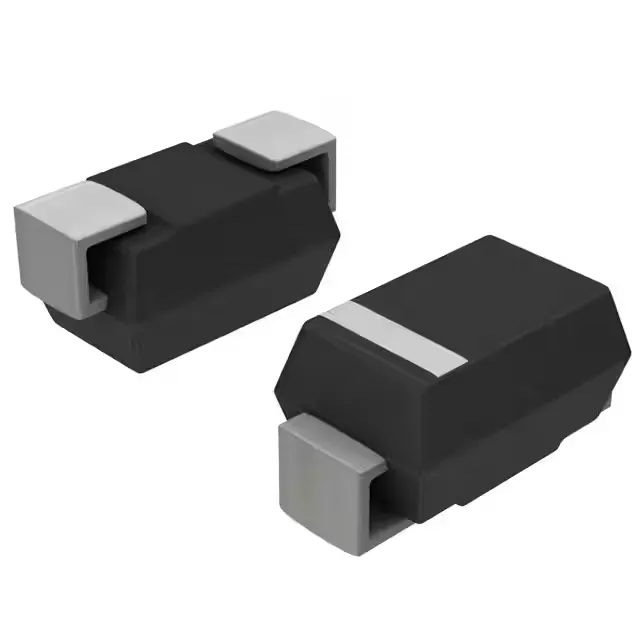
What this TVS protects and how it clamps
Its reverse standoff voltage (Vrwm) is 45V, meaning it does not conduct at normal operating levels on that rail. When a surge exceeds the minimum breakdown voltage of 50V, the device avalanches and clamps the peak voltage to 80.3V at the peak pulse current of 7.5A (10/1000µs waveform).
Package and mounting — DO-214AA SMB
The SMB package is larger than the smaller SMA (DO-214AC) variant, which gives it better thermal mass for repetitive surge handling. The part ships on tape and reel (TR suffix), compatible with automated pick-and-place assembly. Operating temperature spans -65°C to 150°C junction, wider than the commercial 0-70°C range — suitable for outdoor enclosures, industrial cabinets, or under-hood environments where temperature swings are routine.
The base product number is SMBJ45, and the suffix denotes lead-free / RoHS-compliant finish. No official second-source cross-reference is published by Microchip, but the DO-214AA footprint is widely used across the TVS industry; Littelfuse, Vishay, and onsemi offer functionally similar 45V unidirectional TVS diodes in the same package that can be evaluated as alternates.
Application fit and selection note
The unidirectional channel means it clamps only positive transients above the breakdown voltage; for AC or bidirectional protection, two devices back-to-back or a bidirectional TVS would be needed. The 80.3V clamp voltage gives a 35.3V margin above the 45V rail — check that the downstream components (DC-DC converter input, IC supply pins) have an absolute maximum rating above 80.3V. If the rail is 48V nominal (e.g., PoE or telecom), the 45V Vrwm is a tight fit; a 48V or 51V TVS would avoid nuisance triggering during normal ripple.