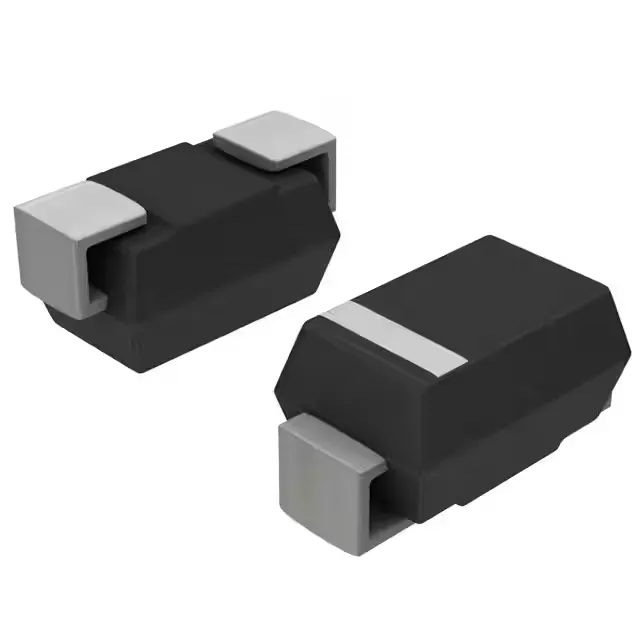
Bidirectional 150V TVS in DO-214AA SMB
Its reverse standoff voltage of 150V means it stays off during normal operation, only conducting when the line exceeds the minimum breakdown voltage of 167V. The clamping voltage peaks at 243V at the rated peak pulse current of 2.5A under the 10/1000µs waveform. This is a single-channel bidirectional device, so it protects AC signal pairs or bipolar DC rails without needing two diodes back-to-back.
Peak Pulse Power and Clamp Performance
The 2.5A peak pulse current at the clamping voltage of 243V gives the circuit designer a clear window for fuse coordination and downstream device withstand. The bidirectional nature means the clamping characteristic is symmetrical — positive and negative transients are clamped to the same absolute voltage level. This simplifies layout for AC-coupled or bipolar circuits where polarity is not fixed.
The DO-214AA (SMB) package has a body width of about 3.6 mm and a height of 2.4 mm, with J-bend leads that self-center during reflow. The cathode band is the only polarity mark — but since this is a bidirectional device, orientation does not matter; the band is present for manufacturing consistency. The pad footprint should follow the SMB land pattern recommended in the datasheet; the thermal pad area under the device is the cathode tab, which also carries the heat to the board copper. Rework with hot air is straightforward: preheat the board to 100-120°C, then direct 300-350°C air at the body for 5-8 seconds until the solder wets. The junction can handle 150°C continuous, so brief rework temperatures are well within the safe operating area. No moisture sensitivity level is listed, but standard MSL 1 handling applies for most SMB TVS diodes — bake at 125°C for 24 hours if the reel has been exposed to high humidity.