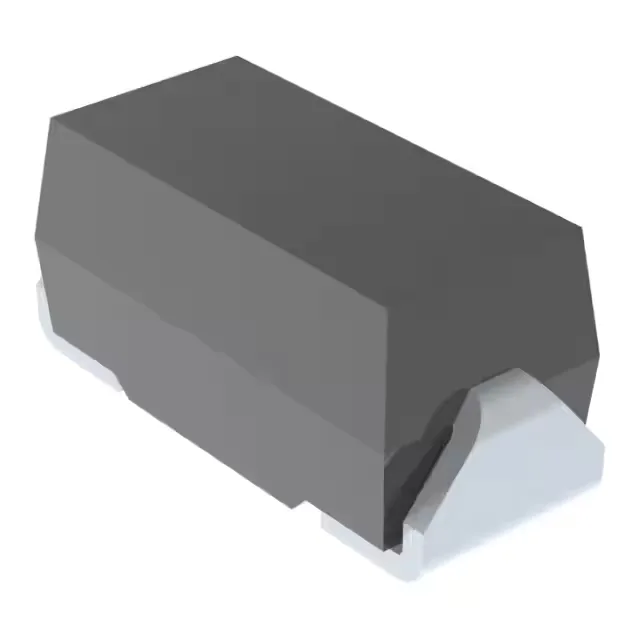
Its 56.7 V minimum breakdown voltage and 91.1 V clamping point mean it triggers before the downstream silicon sees damaging overvoltage, but still leaves enough headroom for normal rail ripple. The 500 W peak pulse rating (10/1000 µs waveform) is the energy it can absorb in a single surge event — useful for protecting 48 V telecom supplies, industrial 48 VDC buses, or automotive 24 V systems where the alternator load-dump transient can spike well above the steady-state rail.
The reverse standoff voltage is 51 V — this is the DC bias the diode sees in normal operation without conducting. Below that, leakage is negligible. The breakdown voltage range starts at 56.7 V; this is where the diode begins to avalanche. If your rail is a tightly regulated 48 V, the margin is comfortable. But if the rail is a 52 V nominal with 5 % tolerance, the worst-case steady-state voltage could sit at 54.6 V, which is only 2.1 V below the breakdown knee — thermal runaway risk goes up. The clamping voltage at the peak pulse current (5.5 A) is 91.1 V, so any spike that exceeds that gets clipped. For a 48 V supply with a 100 V-rated downstream MOSFET, this clamp keeps the drain-source voltage within safe limits.
Package and temperature range for the environment
Housed in a DO-214AC (SMA) surface-mount package, the SMAJ51CE3/TR13 is a standard footprint that reflows on a typical lead-free profile.
Microchip lists this part as Active. That means the BOM line is stable for new designs and production runs — no last-time-buy scramble. The base product number is SMAJ51, so if you need a different voltage variant in the same package, the SMAJ family covers that range.